The short answer
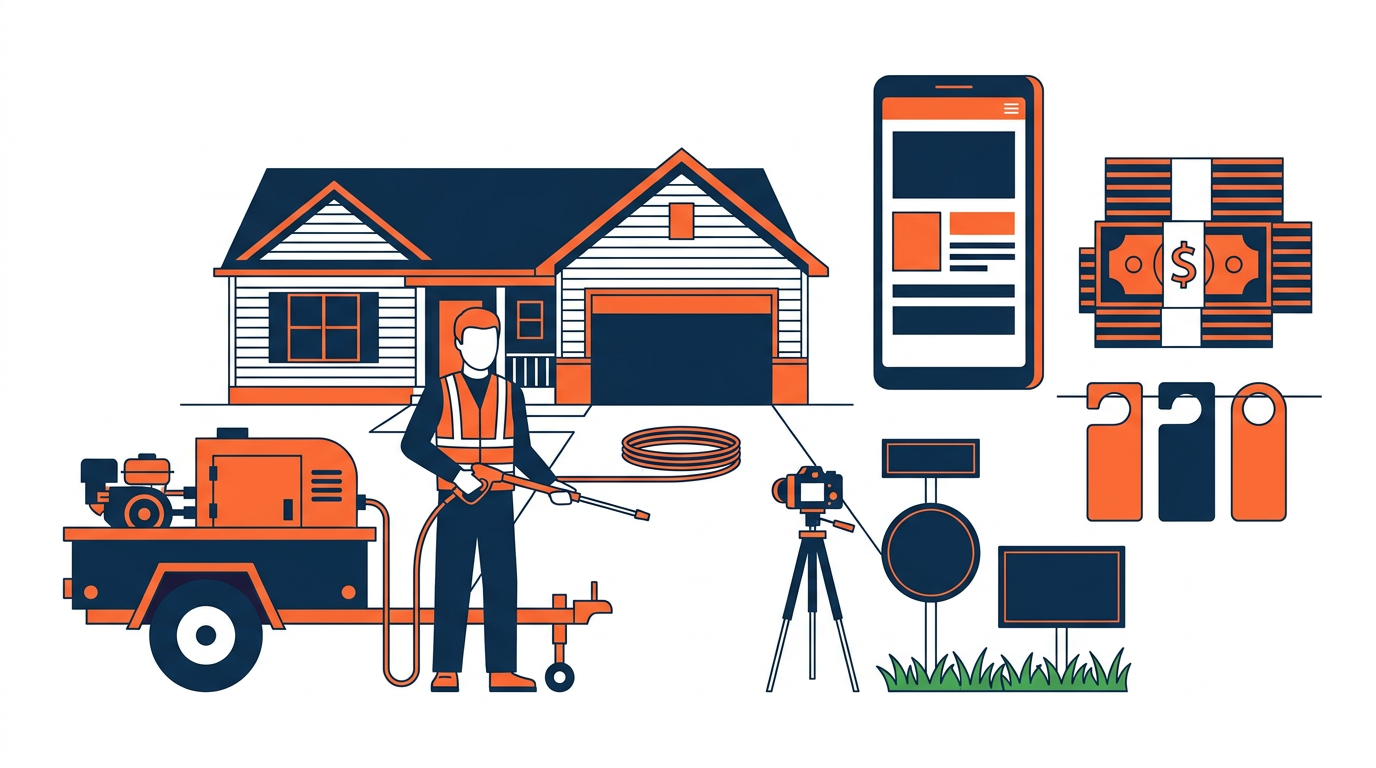
Spend your first $500 on local trust and direct outreach, not broad paid ads. Put about $200 into a fast one-page website, $100 into yard signs, $75 into door hangers, $50 into photo supplies, $50 into quote and review follow-up, and hold $25 for testing. First, complete your Google Business Profile at no cost. This setup gives homeowners several ways to find you, check your work, request a quote, and remember your name.
Key takeaways
- Complete your Google Business Profile before paying for ads.
- Spend $200 on a simple mobile website with one clear quote action.
- Use $175 for signs and door hangers around active jobs.
- Build every marketing piece around real job photos and customer reviews.
- Track calls and quotes before moving money into paid advertising.
Spend the first $500 on six basic marketing tools
Your first $500 should build a working local marketing system, not buy one short burst of attention. Start with assets you control and materials you can place around real jobs.
The plan below assumes you already have a legal business setup, safe equipment, transportation, and appropriate insurance. Marketing cannot cover for sloppy work, poor communication, or prices that fail to support the business.
Use the amounts as spending caps, not instructions to waste every dollar. If you can build a clean page yourself or already own decent photo gear, move the savings into signs, hangers, or a small test.
Keep your service pricing ready before leads arrive. The Pressure Washing Pricing Calculator can help you build quotes around measured work instead of guesses.
| Marketing item | Budget | What it should produce |
|---|---|---|
| Google Business Profile | $0 | Local visibility, calls, directions, and reviews |
| One-page website and domain | $200 | Service proof and quote requests |
| Yard signs | $100 | Neighborhood recognition near active jobs |
| Door hangers | $75 | Direct outreach around completed work |
| Photo supplies | $50 | Consistent job photos for listings and quotes |
| Quote and review follow-up | $50 | Faster responses and more review requests |
| Testing reserve | $25 | Reprints, a new offer, or a small local test |
| Total | $500 | A basic local lead system |
Complete your Google Business Profile before spending a dollar
Set up and complete your profile first because it costs nothing and supports local discovery. Use the same business name, phone number, service area, hours, and website details everywhere.
Google says customers are 2.7 times more likely to consider a business reputable when they find a complete Business Profile on Search and Maps. Google also says complete profiles make customers 70 percent more likely to visit and 50 percent more likely to consider purchasing.
Add your actual services, service area, business hours, phone number, website, and real job photos. Do not stuff the business name with extra services or locations. Follow Google's instructions when you create or manage your Google Business Profile.
Reviews deserve steady attention. BrightLocal's 2026 Local Consumer Review Survey says 97 percent of consumers read local business reviews, while 68 percent will only use businesses rated four stars or higher. The same survey says Google is the most used review platform, used by 71 percent of consumers.
Ask for a review after the customer has seen the finished work and confirmed they are satisfied. Send the direct review link while the job is still fresh, then reply professionally to every review.
Use this Google Business Profile setup for pressure washers to work through the listing without skipping the basics.

Put $200 into a fast one-page website
Your first website only needs to explain what you clean, where you work, why you are credible, and how to request a quote. A clear one-page site is better than an unfinished collection of thin service pages.
Lead with your main service and service area. Add a tap-to-call button, short quote form, real job photos, review excerpts you have permission to use, and a simple list of surfaces you clean.
Design for a phone first. Pew Research Center reported in 2025 that 91 percent of US adults own a smartphone, while 16 percent rely on a smartphone for internet access instead of home broadband.
Speed also affects whether visitors stay and act. Portent's 2022 study of more than 100 million page views found that a site loading in one second had a conversion rate three times higher than one loading in five seconds.
Compress large photos, skip autoplay video, limit extra software, and test the quote form yourself. Read what makes a good pressure washing website before adding features that distract from the call or quote request.
Do not assume a basic site must consume the whole budget. This breakdown of pressure washing website cost can help you separate useful work from unnecessary extras.
Spend $50 making your job photos consistent
Use the $50 photo budget for simple tools that make repeatable images, not expensive camera gear. A phone, clean lens, steady framing, and consistent angles are enough to document your work honestly.
Buy a small tripod, lens cloths, or an inexpensive waterproof phone pouch if you need them. Keep people, house numbers, license plates, and neighboring properties out of the frame when practical.
Take the first photo before moving hoses or starting a test spot. Mark your standing position, then return to the same place after the surface has reached its finished appearance.
Capture one wide shot, one medium view, and several close details. Photograph equipment setup and careful property protection too, because homeowners are judging your process as well as the cleaned surface.
Never edit dirt away, oversaturate concrete, or present another contractor's work as yours. The guide to pressure washing before and after photos covers framing, lighting, and useful shot lists.
Put $175 into signs and door hangers near real jobs
Spend $100 on simple yard signs and $75 on door hangers, then concentrate both around work you are already performing. Tight placement creates repeated local exposure without paying to reach an entire city.
A sign should communicate your service and contact method at a glance. Use a readable business name, a short service description, and one large phone number or web address. Get the customer's permission before placing anything on the property, and follow local placement rules.
Use door hangers on nearby homes after completing the job, not scattered across random neighborhoods. State what you clean, how to request a quote, and that you recently worked nearby only when that statement is true.
Do not print a deep discount that attracts work below your minimum. A simple nearby-service message or bundled quote gives you more room to protect the ticket.
Prepare for the calls these materials create. Your quote should identify the surface, approximate size, included work, exclusions, and total price. Review how to handle “that’s too expensive” before responding by cutting your number on the spot.
Use $50 to tighten quote and review follow-up
Spend $50 on a dedicated business number, basic form tool, or simple follow-up system if your current setup misses messages. The goal is to make every lead easy to answer, track, and close.
Create saved replies for new inquiries, scheduled estimates, appointment reminders, job completion, and review requests. Personalize the name, address, service, and timing before sending anything.
Your first response should confirm that you received the request and state the next step. Ask only for details needed to price or inspect the work, such as address, surface type, approximate dimensions, access issues, and current photos.
Track each lead in a spreadsheet with the source, requested service, quote amount, result, and follow-up date. Mark whether it came from Google, the website, a sign, a hanger, a referral, or another source.
This simple record shows what deserves the next dollar. It also keeps old quotes from disappearing when the homeowner needed time rather than a lower price.
Skip broad paid ads until your foundation can convert leads
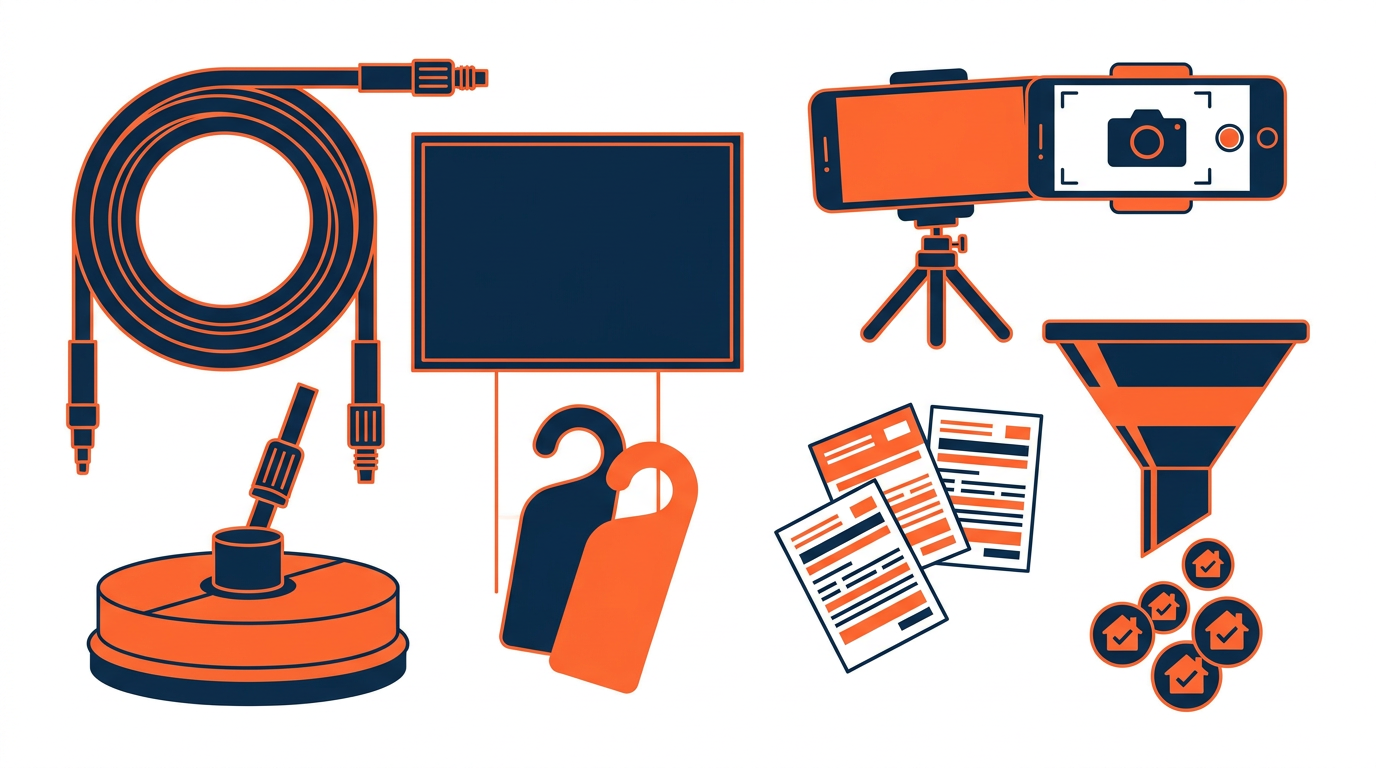
Do not make paid search or social ads the main use of your first $500. Ads can create traffic quickly, but a weak profile, slow page, thin proof, and missed calls can burn the budget without teaching you much.
Build the profile, website, photos, quote process, and follow-up first. Then use the $25 reserve, or later job profit, for one controlled test with one service, one service area, and one landing page.
Organic search is not an instant replacement for ads. Backlinko's analysis of 4 million results found the first organic Google result gets a 27.6 percent click-through rate, and the top three receive 54.4 percent of clicks. That makes rankings valuable, but you still have to earn them.
Start with specific pages that match jobs you want, rather than writing broad filler. Backlinko found four-word search keywords had the highest click-through rate at 31.8 percent. Use the pressure washing SEO guide to plan location and service content around real searches.
If you would rather have the website built while you focus on jobs and follow-up, you can get a WasherAuthority website. Keep ownership, recurring cost, editing access, and lead tracking clear before signing up.
Judge the $500 by booked work, not clicks or impressions
Measure leads, quotes, booked jobs, revenue, and source for at least one normal sales cycle before changing everything. Calls and form submissions matter, but booked work and collected revenue tell you whether the system pays.
Use a separate line for each source in your tracking sheet. Ask every caller how they found you, then compare their answer with form data and call records.
Record total spend by channel and divide it by qualified leads and booked jobs. You do not need complicated software to see whether signs outperform hangers or whether Google produces better-fit work.
Review the numbers on a fixed schedule. Replace weak signs, rewrite confusing web copy, improve slow follow-up, and stop repeating materials that produce no serious inquiries.
Do not scale a channel based on one easy job or kill it after one quiet week. Make one change at a time, keep the offer and service area specific, and preserve enough information to know what caused the result.
Frequently asked questions
Should I spend my first $500 on Google Ads?
Usually not. Complete your Google profile, publish a fast website, gather real photos, and establish reliable follow-up before testing paid traffic.
Is Facebook worth using for pressure washing marketing?
It can support local proof and referrals, but do not depend on unpaid posting alone. Show real work, answer messages promptly, and track booked jobs from the platform.
How many reviews do I need before marketing?
Start marketing immediately and request reviews after every satisfied job. There is no single review count that fits every market, so focus on legitimate, recent feedback.
Should I offer a discount on my first door hangers?
Only if the price still covers travel, labor, chemicals, overhead, and profit. A nearby-job offer or service bundle often protects your minimum better.
When should I increase the marketing budget?
Increase it after you can identify which source produces qualified leads and booked work. Scale one proven channel at a time instead of spreading money everywhere.
Need a website that turns these searches into calls?
We build done-for-you sites for pressure washing contractors. A one time build fee, then $29/month for hosting, your domain, backups and unlimited edits.
Get Your Free Mockup