
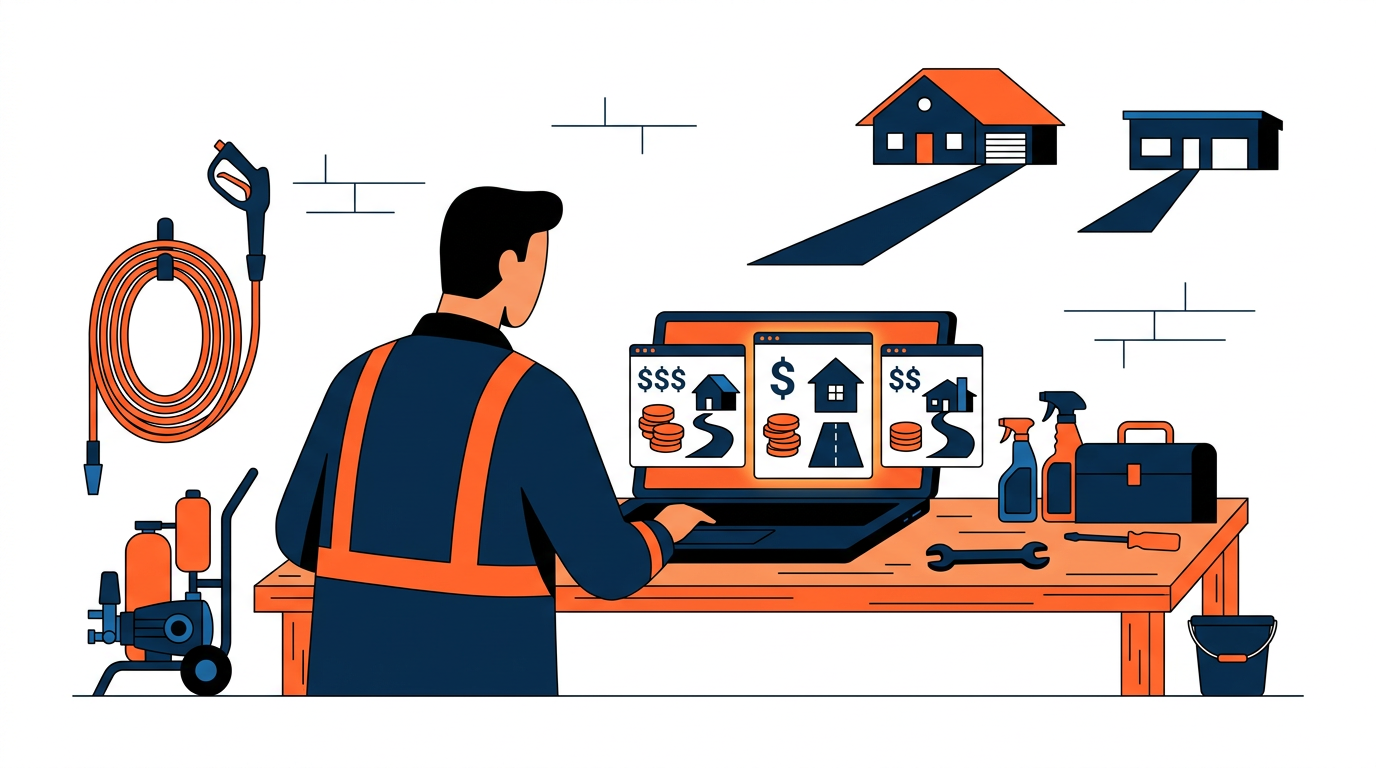
The short answer
No, most new pressure washing contractors do not need a $3,000 agency website. A clean $500 to $1,500 site can cover the basics if it loads well, explains your services, shows your service area, and makes requesting an estimate easy. A $3,000 agency build makes more sense when you already have steady lead flow, serve several markets, or need custom pages and tracking. Judge the purchase by total cost, ownership, support, and booked work, not appearance alone.
Key takeaways
- A practical starter website can fall between $500 and $1,500, while $3,000 should buy deeper strategy and custom work.
- DIY costs less in cash, but you handle writing, setup, updates, tracking, and repairs.
- Ask who owns the domain, website files, copy, photos, forms, and analytics before signing.
- A good site needs clear services, service areas, proof, contact options, and estimate requests.
- Do not spend $3,000 unless the added work supports your current market and sales process.
A $3,000 agency website is useful only when the scope earns its price
A $3,000 website is not automatically expensive or smart. The real question is whether its scope solves problems your business has today.
You are buying a sales tool, not wall art. It should tell a homeowner what you clean, where you work, why you are credible, and how to request an estimate without hunting around.
Market competition gives that tool a real job. IBISWorld counted 32,193 pressure washing services businesses in the United States in 2024, up 5.2 percent from 2023. Your website must separate you from nearby operators, but a bigger invoice does not guarantee that result.
A newer owner with one truck and a tight service radius usually needs a focused site. A larger operation may need separate service pages, location pages, call tracking, conversion tracking, and connections to other systems.
Start by deciding how customers will reach the site. If you expect traffic from referrals, signs, cards, or a business profile, a compact site may work. If you expect to compete across several searches and locations, you need more pages and planning.
Search wording matters too. Backlinko reports that four-word search keywords have the highest click-through rate at 31.8 percent. That supports building pages around specific services and locations instead of stuffing one homepage with every phrase you can imagine.
Before comparing proposals, nail down your services and pricing logic. The Pressure Washing Pricing Calculator can help you organize the offers that your website must present.
DIY, managed, and $3,000 agency websites solve different problems
DIY wins on cash cost, while an agency should win on time saved and depth of execution. A managed setup sits between them when you want help without commissioning a large custom build.
The figures below are working budget ranges, not industry survey results. Actual quotes depend on page count, copywriting, design, forms, integrations, hosting, and ongoing support.
DIY means you choose a platform, structure pages, write copy, source images, connect forms, and maintain everything. That can work if cash is tight and you are comfortable learning software.
A template-based freelancer or managed provider can remove much of that workload. Check whether the package includes hosting, edits, backups, form testing, and ownership when you leave.
An agency build should deliver more than a different color scheme. At $3,000, ask for a written plan covering research, page structure, original copy, mobile design, tracking, launch checks, and handoff.
Also compare ongoing charges, not just the build price. The breakdown in One-Time vs Monthly Pressure Washing Websites can help you examine both payment structures.
| Attribute | DIY website | Template or managed website | $3,000 agency website |
|---|---|---|---|
| Working upfront budget | $100 to $500 | $500 to $1,500 | About $3,000 |
| Your time required | High | Moderate to low | Low during production, moderate for approvals |
| Copy and page planning | You handle it | May be included | Should be included and documented |
| Design | Template selected by you | Adapted template or light customization | Custom or deeply customized |
| Service and location pages | You create them | Limited by package | Should match an agreed scope |
| Tracking setup | You configure it | Basic setup may be included | Should include defined conversion tracking |
| Maintenance | Your responsibility | Often available | Varies by contract |
| Best fit | Cash-tight startup | Busy owner needing a solid foundation | Established operator with broader needs |

Every pressure washing website needs six basic sales elements
Your site needs clear services, service areas, trust signals, straightforward contact options, estimate requests, and mobile-friendly pages. Those six elements matter more than fancy movement or clever slogans.
First, name the work you actually sell. House washing, driveway cleaning, roof soft washing, and commercial cleaning should not be buried inside a long paragraph.
Second, state the towns, counties, or defined radius you serve. A visitor should know immediately whether calling you makes sense.
Third, provide honest proof. Use your own project images when available, explain your process, and list accurate business information. Never fill a new site with fake reviews or work you did not perform.
Fourth, put a phone number and estimate button where a mobile visitor can find them quickly. Test every form after launch and whenever the website changes.
Fifth, make the estimate request useful. Ask for the address, service, contact details, and enough job information to support a follow-up. Do not make the customer complete an inspection report on a phone.
Sixth, give important services their own useful pages. Your house washing page can explain what affects an estimate and point visitors toward your offer. Our guide to How Much to Charge for House Washing helps you align the page with your quoting process.
Keep public price language consistent with what you charge. Angi shows homeowners an average house wash around $310, but your market, access, size, condition, and minimum can produce a different quote. Your website should set expectations without trapping you into one price for every property.
Page count, custom copy, integrations, and support move website cost
Website cost rises when the provider must research, write, design, connect, test, and maintain more pieces. Ask for those pieces as line items so you can compare equal scopes.
Page count is the obvious driver. A five-page brochure site takes less work than a site with individual pages for each service and service area.
Original copy also adds labor. Strong copy requires accurate details about your process, equipment, scheduling, property concerns, and estimate procedure. If you provide polished material, the provider may have less writing to do.
Custom design costs more than adapting a proven layout. Pay extra only when the custom work improves clarity, supports your brand, or fits an unusual sales process.
Integrations can include estimate forms, scheduling tools, customer management systems, call tracking, analytics, and payment tools. Ask who configures each connection and who fixes it when another service changes.
Local search work can increase scope. Creating a page is not the same as guaranteeing placement. Require the provider to describe the actual deliverables, such as page research, titles, internal links, technical checks, or reporting.
Your service mix changes the content workload too. A roof page needs different explanations from a concrete page. Review How Much to Charge for Roof Soft Washing and How Much to Charge for Driveway and Concrete Cleaning when shaping those offers.
Support is another cost mover. Monthly edits, software updates, backups, form monitoring, and performance checks require continuing work. Get the response window and included edit limits in writing.
Set a minimum website budget without starving higher-priority expenses
Set the website minimum at the lowest amount that produces a credible, owned, working site. For many small operators, a $500 to $1,500 working budget is a reasonable place to compare options.
That range is not a universal quote. It is a planning bracket for a focused site built from a sound template, with core pages and basic contact functions.
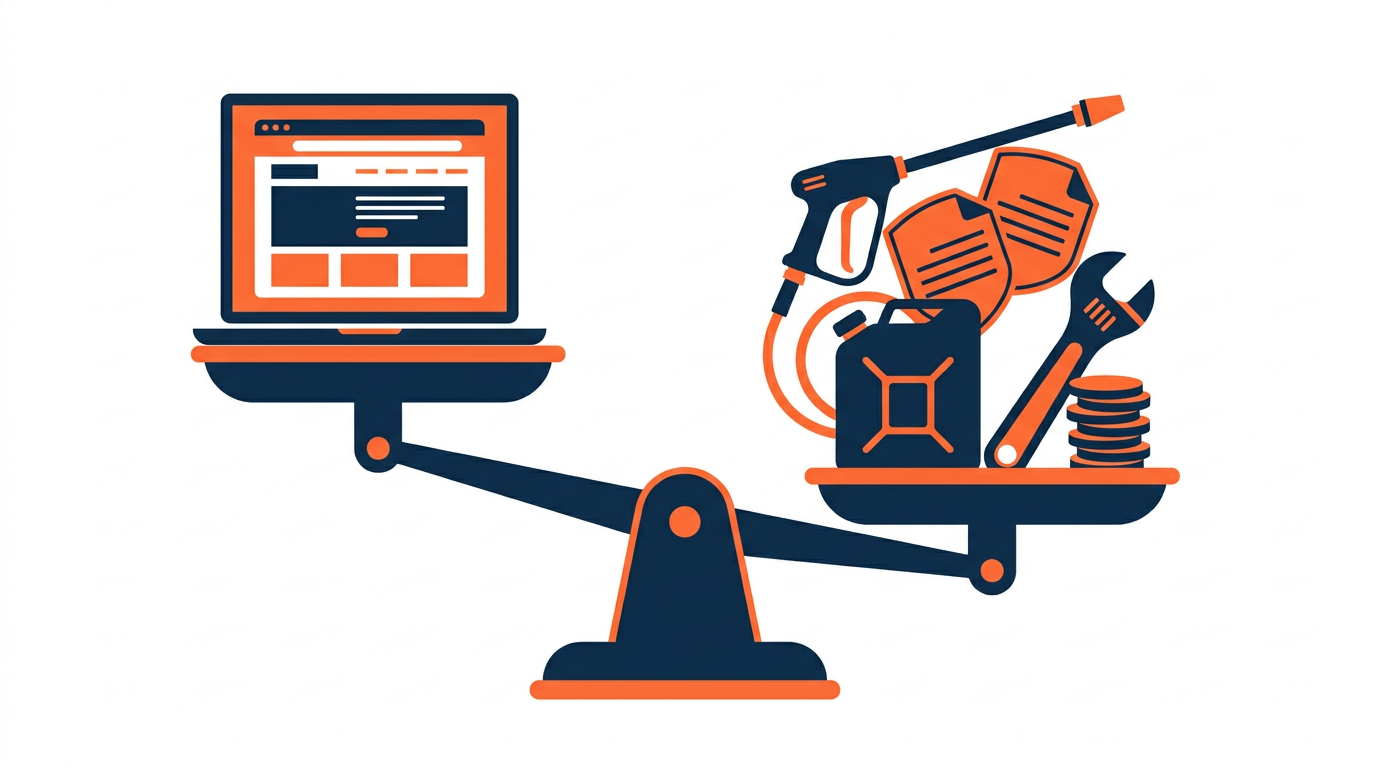
Do not pull the money from operating needs you have not covered. Website design cannot replace insurance, reliable equipment, chemicals, repairs, fuel, or enough cash to complete booked work.
For scale, Insureon reports average annual general liability insurance cost of $895 for pressure washing companies. It reports average annual workers compensation insurance cost of $1,601. Your actual insurance quotes can differ, but these figures show why a $3,000 website must compete against meaningful business expenses.
Separate the build budget from the ongoing budget. Domain renewal, hosting, software, maintenance, call tracking, and future edits can keep costing money after launch.
Also reserve something for bringing qualified people to the site. A website without a traffic plan may receive few opportunities, regardless of its design.
If you are still building your pipeline, use How to Get Your First Pressure Washing Customers to plan outreach alongside the website. The two jobs should support each other.
Choose DIY for cash limits, managed service for time limits, and an agency for complexity
Choose the option that matches your current constraint. Cash-tight owners can use DIY, time-tight owners often need managed help, and complex operations may justify an agency.
Choose DIY when you have more time than money and can accept a learning curve. Keep the first version small, publish accurate information, and improve it as real customer questions appear.
Choose a template-based freelancer or managed provider when you need professional execution but have a straightforward offer. This usually fits an owner who wants to stay on estimates and jobs instead of adjusting page layouts at night.
Consider the $3,000 agency route when you serve several locations, sell several distinct services, run paid traffic, or need stronger tracking and integrations. The agency should show how each deliverable supports that complexity.
Do not choose an expensive build because you feel embarrassed by a simple site. A plain website that answers questions and produces estimate requests can outperform a beautiful site that hides the phone number.
Do not choose the cheapest proposal without checking ownership either. Low upfront cost can become expensive if you cannot move the domain, export the site, access the leads, or keep your content.
When you want a provider to handle the structure and launch, you can Get a WasherAuthority website. Compare its scope and ownership terms against every other option before deciding.
Ask these ownership and performance questions before paying an agency
Ask who owns every asset, what exactly gets delivered, and how results will be measured. If the answers stay vague, do not pay the deposit yet.
Start with the domain. It should be registered in an account you control, using contact information you can access.
Then ask about the website itself. Can you move it to another host? Will you receive administrative access? Are there proprietary components that stop working if you cancel?
Confirm ownership of copy, graphics, project photos, form submissions, and analytics accounts. If the provider supplies licensed images or software, ask what usage rights continue after the agreement ends.
Request a page list and a revision limit. Define whether mobile layout, form testing, basic accessibility work, analytics, redirects, and launch support are included.
Ask what counts as a lead. A form submission, tap-to-call action, and booked estimate are different events. You need tracking that matches the way your business closes work.
Finally, define maintenance. Ask who updates software, checks forms, restores backups, and handles urgent failures. Get the monthly cost and cancellation process in writing.
You do not need a promise of instant rankings. You need a usable asset, clean access, clear responsibilities, and reporting you can understand between jobs.
Frequently asked questions
How much should a new pressure washing business spend on a website?
A working budget of $500 to $1,500 can cover a focused starter site. Spend less through DIY if you can handle setup and maintenance yourself.
Is a one-page website enough for pressure washing?
It can work temporarily for one service area and a small service list. Separate useful service pages become more valuable as your offers and markets expand.
Should website hosting be included in the build price?
It can be included or separate. Ask for the renewal cost, support level, backup policy, cancellation terms, and migration options before signing.
How do I know whether my website produces work?
Track calls, estimate forms, booked estimates, and sold jobs by source. Traffic alone does not tell you whether the website supports revenue.
Who should own my pressure washing website domain?
Your business should control the domain account and login. Do not rely on a provider's account for an address tied to your name and customer traffic.
Need a website that turns these searches into calls?
We build done-for-you sites for pressure washing contractors. A one time build fee, then $29/month for hosting, your domain, backups and unlimited edits.
Get Your Free Mockup