
The short answer
When a customer says your pressure washing quote is too expensive, do not cut the price immediately. Use a seven-step response: pause, acknowledge the concern, ask what they expected, confirm the scope, explain the result, offer scope-based options, and ask for the job. If the customer still wants an unworkable price, politely walk away. Your goal is not to win every quote. It is to find the real objection and protect the rate required to complete the work properly.
Key takeaways
- Ask what the customer expected before defending or discounting your quote.
- Explain the scope and result in plain language, not a long speech about your company.
- Trade scope for price instead of giving the same work away for less.
- Use clear options, then ask directly which one the customer wants.
- Walk away when the requested price cannot support a properly completed job.
Step 1: Pause before answering the price objection
Pause for a moment, then answer calmly. Do not treat “That’s too expensive” as a final rejection or start negotiating against yourself.
A simple response works: “I understand. Which part feels higher than you expected?” Then stop talking and let the customer answer.
The pause matters because contractors often rush to fill silence with a discount. Once you volunteer a lower number, the customer learns that your first quote was movable.
Keep your tone normal. You are gathering information, not defending yourself in court. The customer may be comparing your quote with another contractor, an online estimate, a past cleaning, or a number they made up.
That difference changes your next move. You cannot answer the real concern until you know what it is.
Step 2: Ask what price or scope the customer expected
Ask what the customer expected to spend and what they believed the quote included. One direct question can separate a true budget problem from a misunderstanding.
Try: “What range were you expecting?” You can also ask, “Are you comparing the same areas and cleaning method?”
Consumer estimate sites can shape expectations before you arrive. Angi shows homeowners an average house wash around $310, but one average cannot account for every home’s size, height, access, buildup, or requested add-ons.
Do not argue with an online number. Bring the conversation back to the actual property and written scope.
If another contractor quoted less, ask whether that quote includes the same surfaces, preparation, treatment, and cleanup. Do not attack the other contractor. You usually have not seen their process, equipment, or written terms.
Your job is to expose the comparison. “Cheaper” means little when the two quotes cover different work.
Step 3: Confirm every surface and task in the quote
Read back the scope in a short, specific list. Customers resist a large total less often when they can see exactly what the number covers.
Say something like: “This includes the siding, soffits, exterior gutters, covered entry, treatment, setup, and cleanup.” Adjust that sentence to match your quote.
Separate similar services that customers may confuse. A house wash is not automatically a roof treatment, concrete cleaning, gutter debris removal, or gutter brightening. The guide to House Washing vs Pressure Washing: What to Sell and When can help you name the correct service before quoting it.
Your estimate should also identify exclusions. If oxidation removal, rust treatment, stain removal, water access issues, or moving heavy items requires separate approval, say so before scheduling.
For house work, compare your numbers with How Much to Charge for House Washing. For concrete, use How Much to Charge for Driveway and Concrete Cleaning to check whether your scope and price line up.
Never add tasks verbally just to rescue the sale. Update the written quote whenever the scope changes.
Step 4: Explain what moves the price without giving a speech
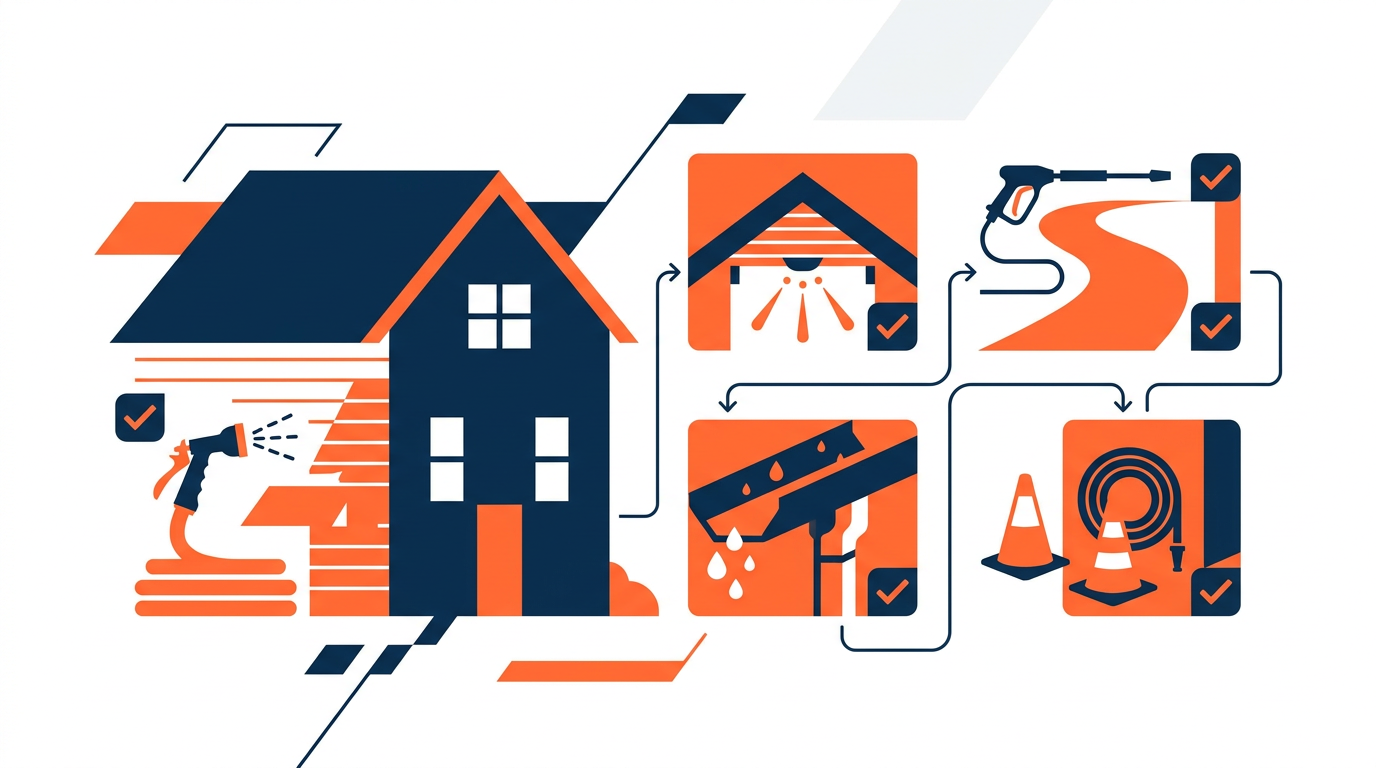
Explain two or three job-specific price drivers, then stop. The customer needs a reason for the number, not your complete business history.
Useful drivers include surface area, building height, access, setup, buildup, treatment needs, nearby property protection, and separate surfaces. A second story adds reach and movement. Tight access slows setup. Heavy organic buildup may require more treatment and dwell time.
Use concrete language: “The rear access and second-story sections add setup time, and the detached garage adds another surface area.” That is stronger than saying, “We provide premium service.”
Your pricing method should produce a number you can explain consistently. Per Square Foot vs Flat Rate Pricing for Pressure Washing covers two common ways to build the quote. You can also run the job through the Pressure Washing Pricing Calculator before sending it.
Do not dump every overhead cost on the homeowner. Still, remember that the quote must support a real business. Insureon reports that general liability insurance for pressure washing companies averages $895 per year. That is one cost of operating, not a line item to debate at the kitchen table.
Experienced operators explain the property conditions, connect them to the work, and return to the decision.
Step 5: Show the expected result instead of claiming better quality
Show proof that matches the surface the customer wants cleaned. Specific photos and a clear process carry more weight than calling yourself the best.
Use a small set of relevant before-and-after images. A driveway prospect should see concrete work. A house-wash prospect should see siding with similar buildup, color, or access.
Follow How to Take Pressure Washing Before and After Photos That Sell Jobs so your images use consistent angles and show the work clearly. Do not promise that every stain or defect will disappear if you cannot control that result.
Then explain the outcome in one sentence: “The quote is for cleaning the listed surfaces and treating the visible organic buildup, with the exclusions written below.”
Avoid vague promises such as “like new.” Paint failure, oxidation, permanent staining, damaged concrete, and existing wear are not cleaning results you should guarantee. Set the expected finish before taking payment.
Step 6: Offer a smaller scope instead of an automatic discount
If the customer has a real budget limit, reduce the scope before reducing the rate. The lower price should buy less work, not the identical job.
Give no more than two or three clear options. Too many choices turn a simple decision into another shopping project.
| Customer concern | Your response | Scope-based option | |---|---|---| | Total is over budget | Ask which areas matter most | Clean the house now, price the concrete separately | | Add-ons raised the total | Separate core work from extras | Remove gutter brightening or another optional service | | Another quote is lower | Confirm both written scopes | Match the requested surfaces, not an unknown price | | Customer wants a discount | Ask what they want removed | Reduce square footage or defer a separate area | | Timing is the problem | Keep the approved scope clear | Leave the quote open for later acceptance |
A useful line is: “I can lower the total by removing the driveway, but I cannot do the full scope properly at that lower number.”
Do not hide a discount by throwing in free surfaces. That still cuts your rate and makes the written scope unclear.
If you decide to offer a package price, show which services are included and what each option costs. The customer should be able to compare the choices without calling you for translation.
Step 7: Ask for the job once, then be ready to walk away
After answering the concern, ask for a decision. If the customer still demands an unworkable price, politely release the job.
Try: “Would you like the full scope, or the option without the driveway?” This gives the customer a clear next action without sounding desperate.
If neither option works, say: “I understand. I may not be the right fit at that budget, but I appreciate the opportunity to quote it.” Leave the door open and end the negotiation cleanly.
Do not keep sending lower totals after every silence. Endless follow-up teaches the prospect to wait for another concession.
You can reduce future objections by attracting customers with accurate service pages, relevant work photos, and clear quote language. How to Get Your First Pressure Washing Customers covers practical customer acquisition without making price your only selling point.
Your website should also explain what each service includes before the customer requests a quote. If your current site cannot do that, you can get a WasherAuthority website built around your services and local market.
These five mistakes make price objections harder to close
The worst mistakes are instant discounting, arguing, vague scope, overexplaining, and refusing to walk away. Each one weakens trust or turns the conversation into a price fight.
1. Discounting before asking a question. You do not know whether price is the real issue. The customer may be confused about the scope or simply testing your number.
2. Criticizing the cheaper contractor. You probably do not know what that contractor included. Compare written scope, method, and expected result instead.
3. Using vague quote descriptions. “Pressure wash house” leaves too much room for assumptions. List surfaces, included tasks, exclusions, and optional work.
4. Talking only about equipment and overhead. Customers care about their property and result. Explain how job conditions affect the work, then ask for the decision.
5. Taking work below your floor. A booked calendar does not fix a job that cannot support the required labor, chemicals, travel, setup, and risk. Know your minimum before you send the quote.
Competition can influence local expectations. IBISWorld reported 32,193 pressure washing services businesses in the United States as of 2024, up 5.2 percent from 2023. That does not mean you must copy the lowest quote. It means your scope and sales process must be easy to understand.
Frequently asked questions
Should I ask a customer what another contractor quoted?
You can ask, but focus on whether both quotes include the same surfaces and tasks. Do not criticize a quote you have not reviewed.
How much should I discount a pressure washing quote?
Start with no discount. If the budget is firm, remove or defer part of the scope so the lower total reflects less work.
What if the customer says they need to think about it?
Confirm which option they are considering, set a reasonable follow-up point, and leave the quote unchanged unless the scope changes.
Should every pressure washing job have a minimum charge?
Yes. Set a minimum that covers travel, setup, treatment, work, cleanup, and the cost of reserving that time.
What should I say when another contractor is much cheaper?
Say, “Let’s confirm that both quotes cover the same work.” Compare written scope and expected results rather than chasing an unknown number.
Need a website that turns these searches into calls?
We build done-for-you sites for pressure washing contractors. A one time build fee, then $29/month for hosting, your domain, backups and unlimited edits.
Get Your Free Mockup