
The short answer
Use per-square-foot pricing to build consistent estimates, then present a flat total to the customer. Square-foot rates work best for measurable surfaces such as siding, roofs, driveways, and concrete. Flat rates work better for repeatable jobs with predictable labor and access. A solid hybrid model starts with rates such as $0.25 to $0.35 per square foot for house washing, adjusts for job conditions, applies your minimum, and gives the customer one clear price.
Key takeaways
- Use square footage as your estimating tool, even when the customer sees only a flat total.
- House washing commonly runs $0.25 to $0.35 per square foot before condition and access adjustments.
- Flat rates fit standardized jobs, while square-foot rates protect you on large or irregular properties.
- Set a minimum charge that covers travel, setup, breakdown, and administrative time.
- Use a hybrid model when measurable size alone does not reflect the actual labor.
A hybrid pricing model gives most pressure washing contractors the best control
The strongest default is to calculate by square footage, adjust for difficulty, and quote one flat total. You keep a repeatable estimating system without making the customer work through your math.
Straight square-foot pricing can undercharge tight, dirty, or obstructed jobs. Pure flat-rate pricing can turn into guessing when property sizes vary. The hybrid approach solves both problems because your internal calculation remains measurable while the proposal stays simple.
For example, measure a house, apply your normal house-washing rate, then add for two stories, difficult access, heavy buildup, or extra protection work. Round the result into a clean project total after checking your minimum.
This also makes estimating easier to teach. A helper or salesperson can follow the same base rates and adjustment rules instead of inventing a number in the driveway.
| Pricing model | Best use | Main advantage | Main risk |
|---|---|---|---|
| Per square foot | Large, measurable surfaces | Consistent starting point | Ignores difficulty if used alone |
| Flat rate | Repeatable jobs with known scope | Simple customer-facing price | Can become guesswork |
| Hybrid | Most residential washing | Measurable estimate and clear quote | Requires written adjustment rules |
Per-square-foot pricing works best when size drives labor and material use
Use per-square-foot pricing when you can measure the cleaning surface accurately and larger areas generally require more work. Houses, roofs, driveways, patios, and broad concrete areas usually fit this model.
The table below gives practical starting ranges. These are working anchors, not automatic quotes. Your final number still needs to reflect access, condition, height, water availability, protection work, and the amount of edging or detail cleaning.
A house wash commonly starts around $0.25 to $0.35 per square foot. Review How Much to Charge for House Washing when building a separate rate card for siding work.
Driveway and concrete pricing spans a wider $0.20 to $0.55 per square foot because condition and layout can change production sharply. The guide to How Much to Charge for Driveway and Concrete Cleaning covers that service in more depth.
Roof soft washing usually starts higher because chemical use, safety planning, runoff control, and access deserve more weight. Use How Much to Charge for Roof Soft Washing to tighten that estimate.
Do not copy a low regional number without understanding its market. Softwash Technologies reports that some South Florida operators charge $0.12 to $0.20 per square foot for house washing because of dense competition. That range sits below the broader working anchor and should not become your default elsewhere.
| Service | Working range | Primary billing unit |
|---|---|---|
| House washing | $0.25 to $0.35 | Per square foot |
| Roof soft washing | $0.40 to $0.60 | Per square foot |
| Driveway and concrete cleaning | $0.20 to $0.55 | Per square foot |
| Concrete sealing | $0.75 to $1.25 | Per square foot |
| Gutter brightening | $1.00 to $1.50 | Per linear foot |
Flat-rate pricing works best when the scope is standardized and predictable
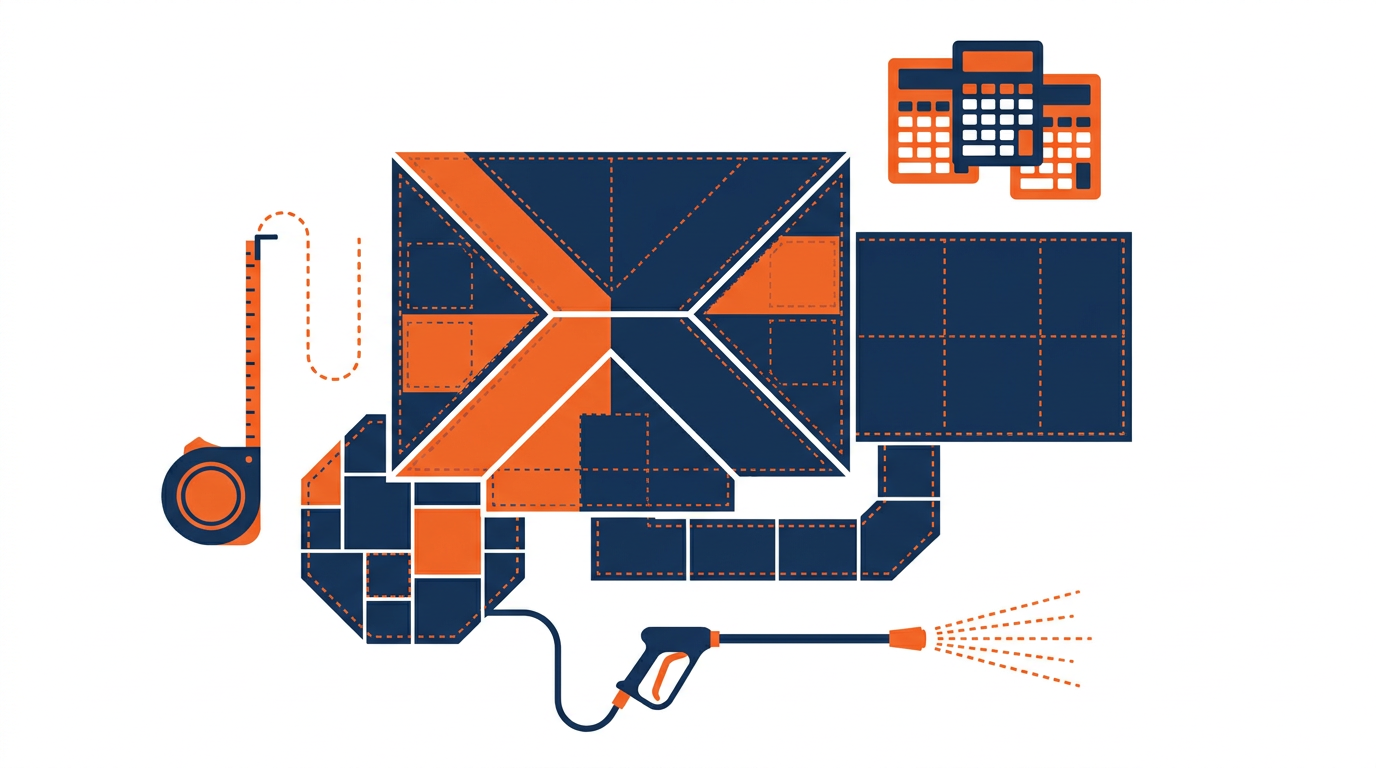
Use a flat rate when you already know the likely labor, chemical use, access, and setup requirements. This works well for repeat properties, small defined areas, and service packages with firm scope limits.
A flat rate is not a number chosen by instinct. Build it from expected labor, operating costs, material use, travel, and the profit the job needs. Check that total against comparable completed work before using it as a standard package.
Flat pricing is especially useful when explaining a quote. The customer receives one number tied to a written scope, rather than debating your measurements or multiplying a rate.
The danger is scope drift. A flat house-wash package must state what surfaces are included, how detached structures are handled, and whether specialty stain treatment costs extra. Without boundaries, your simple package can quietly gain an hour of unpaid work.
Consumer expectations may also shape the conversation. Angi shows homeowners an average house-wash cost around $310. That does not set your rate, but it can explain why a customer arrives with a number already in mind. Your property-specific scope and costs still control the bid.
Per-square-foot and flat-rate pricing handle risk differently
Per-square-foot pricing handles size risk better, while flat rates handle communication better. Your choice should follow the part of the job most likely to hurt your margin.
On a large open driveway, measurement gives you a dependable base. On a small recurring storefront with known access and predictable buildup, a flat rate may be quicker and easier.
Irregular layouts expose the weakness of both models. A square-foot rate may miss edges, obstacles, drainage problems, and slow wand work. A flat rate may miss an unusually large area if nobody confirms the measurements.
That is why the hybrid method wins for most residential estimates. Measure first, adjust second, and present the final project price. Use the Pressure Washing Pricing Calculator to test the rate and total before sending your quote.
| Attribute | Per square foot | Flat rate | Hybrid |
|---|---|---|---|
| Estimate consistency | Strong | Depends on package rules | Strong |
| Customer simplicity | Moderate | Strong | Strong |
| Protection against size changes | Strong | Weak without scope limits | Strong |
| Protection against difficult conditions | Weak without adjustments | Moderate if categorized correctly | Strong |
| Speed on repeat work | Moderate | Strong | Strong |
| Training a new estimator | Straightforward | Hard without job history | Straightforward with rules |
Access, height, condition, and job complexity move the final price
The base rate measures surface area, but job conditions determine whether that rate remains profitable. Adjust the estimate before presenting a flat total.
Height is one of the clearest adjustments. A two-story house generally costs about 25 percent more because access, hose management, and application work become more demanding. Apply that adjustment consistently instead of changing it based on how busy you are.
Heavy organic buildup, oxidation concerns, delicate materials, blocked access, steep grades, and extensive plant protection can all slow production. They may also increase chemical use or require a different process.
Layout matters too. One open 2,000-square-foot concrete area is not the same job as several smaller pads totaling 2,000 square feet. More edges, gates, furniture, transitions, and hose moves mean more non-cleaning time.
Travel and water access belong in the estimate as well. A distant property or poor water supply can consume time that never appears in the square-foot count.
Write adjustment rules into your rate sheet. For example, define a two-story multiplier, an access charge, and condition categories. A repeatable rule keeps your quote grounded when the property is harder than normal.
| Price factor | What to inspect | Pricing response |
|---|---|---|
| Height | Stories and safe access | Add about 25 percent for two stories |
| Condition | Buildup, stains, and neglected areas | Increase rate or add scoped treatment |
| Layout | Edges, gates, obstacles, and separate pads | Add labor allowance |
| Protection | Plants, outlets, fixtures, and adjacent materials | Add setup and monitoring time |
| Travel | Drive time and route fit | Apply travel charge or higher minimum |
| Water access | Supply location and usable flow | Add time or equipment cost when needed |
Every pricing model needs a minimum service charge
Set a minimum that covers the entire stop, not only the minutes spent spraying. Travel, unloading, setup, customer communication, breakdown, payment, and schedule gaps all cost money.
There is no single correct minimum for every contractor. Build yours from the cost of sending the truck, your required labor return, expected materials, overhead, and desired profit. Then check whether the minimum makes sense for your normal service radius.
Insurance belongs in overhead. Insureon reports average annual costs of $895 for general liability insurance and $1,601 for workers compensation insurance among pressure washing companies. Your actual premiums may differ, but these expenses show why a small job cannot be priced from wash time alone.
Apply the minimum after calculating the job. If a 300-square-foot concrete area at $0.30 produces a $90 base estimate, but your minimum is higher, quote the minimum. Do not lower the minimum because the surface looked quick from the curb.
You can protect value by packaging nearby tasks. Offer steps, a short walkway, or another clearly scoped surface when doing so fits the minimum. Do not promise unlimited extras. Each added surface still needs defined boundaries.
Choose the model based on the surface, repeatability, and uncertainty
Choose per square foot for large measurable surfaces, flat rate for standardized repeat jobs, and hybrid pricing for most residential estimates. The more uncertainty a job carries, the more important measurement and written adjustments become.
Use per-square-foot pricing for a large driveway, roof, house exterior, or concrete lot when dimensions are available. Apply service-specific rates and inspect the property before locking the total.
Use a flat rate for a recurring storefront, a small defined patio package, or a property you have already cleaned under similar conditions. Recheck the scope periodically so the package does not stay frozen while conditions change.
Use hybrid pricing for a two-story house with mixed siding, landscaping, and restricted rear access. Start with measured area, add about 25 percent for the second story, account for access and protection, then quote one total.
Keep the quote specific. Name included surfaces, excluded treatments, access assumptions, and what would trigger a price change. Clear scope protects the price better than a long explanation of your rate.
If inconsistent estimates are keeping you from marketing confidently, first tighten your rate card and quote process. Then review How to Get Your First Pressure Washing Customers and, when you need a site built around clear services and estimates, Get a WasherAuthority website.
| Situation | Recommended model | Reason |
|---|---|---|
| Large open driveway | Per square foot | Area closely tracks the base workload |
| First-time house wash | Hybrid | Measurement needs condition and access adjustments |
| Repeat storefront | Flat rate | Scope and production are already known |
| Two-story home | Hybrid | Area alone misses added height and access |
| Small job below your threshold | Minimum charge | The full service stop must be covered |
Frequently asked questions
Should customers see the per-square-foot rate?
Not necessarily. You can calculate from square footage internally and present one flat project total with a clear scope.
How much should I charge per square foot for house washing?
A practical starting range is $0.25 to $0.35 per square foot. Adjust for stories, access, condition, protection work, and your minimum.
Do I charge for the home footprint or the siding area?
Use the measurement method built into your rate. Siding area is more direct, but another consistent method can work if your rate was developed for it.
Should concrete cleaning have the same rate as house washing?
No. Concrete cleaning commonly runs $0.20 to $0.55 per square foot, while house washing commonly runs $0.25 to $0.35.
When should I raise a flat-rate quote?
Raise it when the measured scope, access, condition, height, travel, or required protection exceeds the assumptions behind your standard package.
Need a website that turns these searches into calls?
We build done-for-you sites for pressure washing contractors. A one time build fee, then $29/month for hosting, your domain, backups and unlimited edits.
Get Your Free Mockup