The short answer
To start a pressure washing business, choose a narrow service list, register the company, confirm local permits, buy insurance, build a practical equipment setup, set profitable prices, create a basic local presence, and sell your first jobs. Follow the 8 steps below in order. Do not begin with every service or the biggest machine you can finance. Start with work you can perform safely and repeatably, then expand after your pricing and job process hold up.
Key takeaways
- Start with one or two repeatable services instead of offering every exterior cleaning job.
- Register the business, check local permits, get an EIN if needed, and separate business finances.
- Carry appropriate insurance before taking jobs, and price coverage into your overhead.
- Set minimum charges and estimate labor, chemicals, fuel, travel, and risk before quoting.
- Build a Google Business Profile and simple website, then ask directly for the first jobs.
Step 1: Choose one or two services you can deliver consistently
Start with one or two services that match your equipment, training, and local property types. Driveway cleaning and basic house washing make a practical starting lane for many operators, but only offer work you can complete without guessing.
Write down exactly what each service includes. For a house wash, define which exterior surfaces are covered, what is excluded, whether exterior windows receive a rinse, and how you handle delicate areas. For concrete, define pretreatment, surface cleaning, edge work, and post-treatment.
Avoid adding roofs, sealing, gutters, commercial work, decks, and specialty stain removal on day one. Every added service brings different chemicals, surface risks, estimating needs, and customer expectations.
Study pricing before picking your lane. Review How Much to Charge for Driveway and Concrete Cleaning and How Much to Charge for House Washing to understand how job type changes estimating.
There is real competition. IBISWorld reported 32,193 pressure washing services businesses in the United States as of 2024, up 5.2 percent from 2023. That makes a clear offer and reliable execution more useful than a long menu.
Step 2: Register the business and separate the money
Choose a business structure, register where required, and open separate financial accounts before collecting payments. Your exact requirements depend on your state, county, and city, so confirm them with the agencies that govern your location.
Use the SBA guide to register your business as a starting checklist. Then check your state and local rules rather than assuming another contractor's setup applies to you.
Confirm whether your area requires a general business license, contractor registration, environmental permit, or other approval. The SBA also provides a starting point for researching business licenses and permits.
Get an EIN when your structure or business needs call for one. Put job income into a business bank account, use a dedicated card for expenses, and record every purchase. Keep digital copies of receipts for equipment, chemicals, fuel, advertising, insurance, repairs, and software.
Set aside money for taxes as revenue comes in. Do not wait until the end of the year to discover that money collected from customers was not all available to spend. A bookkeeper or tax professional can help you build a system that fits your situation.
Step 3: Buy insurance before you clean customer property
Get appropriate insurance before your first paid job, and ask an agent to explain exclusions in plain language. Pressure washing can damage siding, paint, windows, landscaping, electrical components, and customer belongings when the process goes wrong.
Insureon reports that general liability insurance for pressure washing companies averages $895 per year. That figure is an average, not your quote. Your location, payroll, revenue, services, limits, equipment, and claims history can move the cost.
If you hire workers, discuss workers compensation requirements and coverage with a qualified agent. Insureon reports an average workers compensation cost of $1,601 per year for pressure washing companies. State rules and your actual operation determine what you need.
Tell the agent exactly what you plan to clean. Roof work, commercial sites, vehicle use, employees, subcontractors, and higher-risk surfaces may affect the policy. Ask whether your tools and machines need separate property or inland marine coverage, and whether the vehicle requires commercial auto coverage.
Save certificates where you can reach them from your phone. Commercial contacts and cautious homeowners may request proof before approving work.
Step 4: Build a simple equipment setup around your chosen work
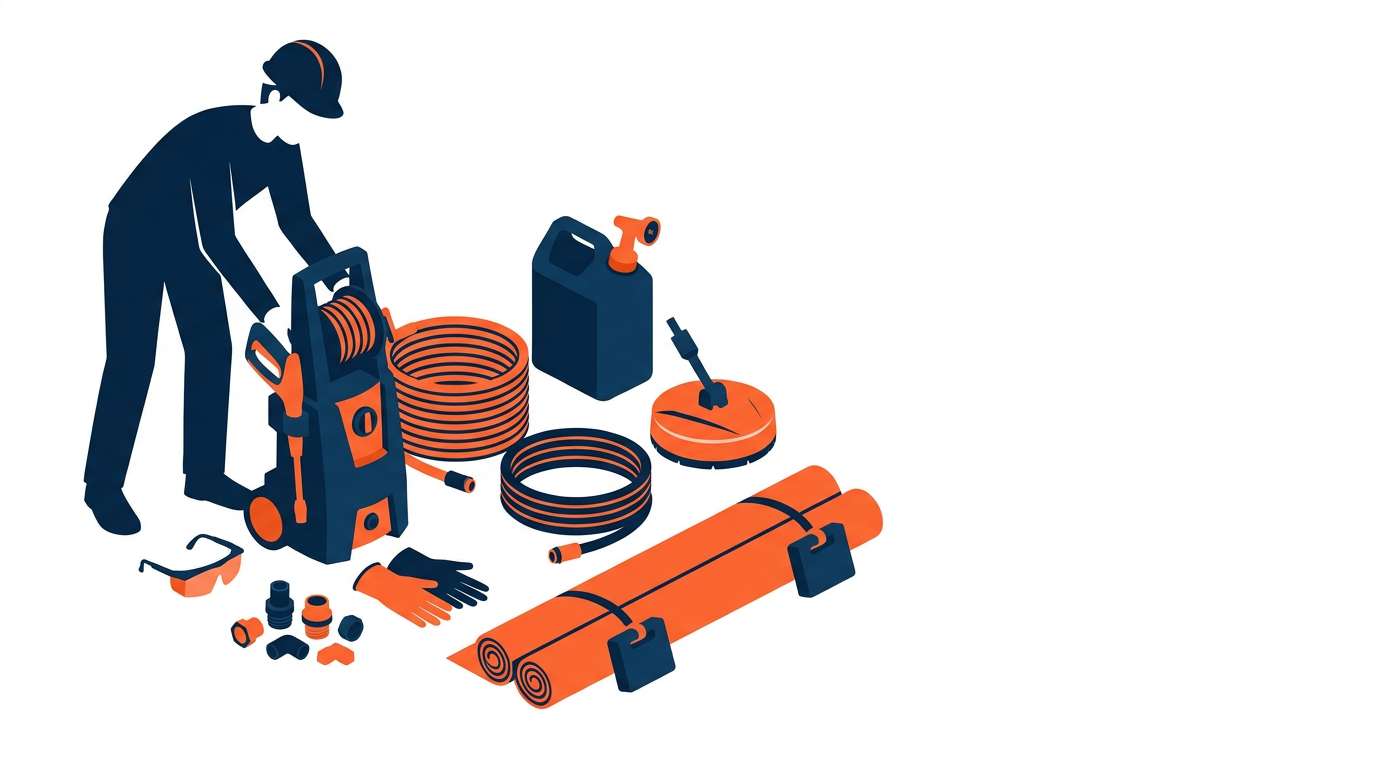
Buy equipment that completes your starting services safely, not a trailer full of gear you cannot keep busy. Your setup should cover water delivery, chemical application, rinsing, surface cleaning, hose management, personal protection, and spill response.
At minimum, match the pressure washer's output to your hoses, guns, tips, and surface cleaner. Carry spare O-rings, tips, fittings, a backup gun, basic tools, and enough hose to work without dragging the machine beside every wall.
For house washing, use an application method that lets the cleaning solution do the work. High pressure is not the default answer for siding, painted surfaces, seals, screens, or oxidation. Learn chemical handling, dilution, dwell time, plant protection, and thorough rinsing before selling the service.
For concrete, use a properly matched surface cleaner and test an inconspicuous area. Uneven passes, excessive pressure, and poor tip control can leave visible lines or damage weaker concrete.
Carry eye protection, gloves, suitable footwear, hearing protection, and any task-specific protection required by the product label or job conditions. Inspect hoses, fittings, triggers, ladders, and electrical hazards before starting.
Plan for wash water instead of letting runoff become an afterthought. The EPA's NPDES program is a useful federal starting point, but you must also check state and local discharge rules. Know where water, detergent, oil, and loosened debris will travel before pulling the trigger.
| Setup area | What it must handle | Buying priority |
|---|---|---|
| Pressure and flow | Your selected service, hose length, and attachments | Match the complete system, not one machine number |
| Chemical application | Controlled application and rinsing | Use compatible equipment and follow product labels |
| Concrete cleaning | Even passes on appropriate flatwork | Match the surface cleaner to the pressure washer |
| Hose management | Safe reach around structures and landscaping | Carry enough hose plus spare fittings and O-rings |
| Personal protection | Chemical, noise, splash, and slip exposure | Choose protection for the task and product |
| Job backup | Common field failures | Carry spare tips, gun, fittings, tools, and repair parts |
Step 5: Set prices from job cost, time, and risk
Build a price floor before quoting customers, then adjust for size, condition, access, and risk. A low square-foot rate does not save you when travel, setup, chemical use, and cleanup eat the job.
Start by estimating labor time from arrival through departure. Add chemicals, fuel, water arrangements, card fees, equipment wear, insurance, advertising, office time, taxes, and the profit needed to keep operating. Then compare the result with the working market range for that service.
Typical working ranges are $0.25 to $0.35 per square foot for house washing and $0.20 to $0.55 per square foot for driveway and concrete cleaning. Roof soft washing commonly runs $0.40 to $0.60 per square foot. Two-story houses are often about 25 percent more because access, time, and risk increase.
Markets can fall outside those ranges. Softwash Technologies reports that some South Florida operators charge $0.12 to $0.20 per square foot for house washing because of competition density. Do not copy that rate unless your own costs, job speed, and market support it.
Use the Pressure Washing Pricing Calculator to work through job numbers, then compare Per Square Foot vs Flat Rate Pricing for Pressure Washing. Square-foot pricing creates consistency, while a customer-facing flat quote can keep the proposal simple.
Set a minimum charge for any trip. Your minimum should cover travel, unloading, setup, cleaning, packing, payment processing, and office work. If a tiny walkway cannot carry those costs, bundle it with another service or decline it.
Do not anchor every quote to a consumer average. Angi shows homeowners an average house wash around $310, but a specific property's size, stories, access, soil level, and delicate materials determine whether that number fits.
| Service | Typical working range | Main estimating concern |
|---|---|---|
| House washing | $0.25 to $0.35 per sq ft | Stories, access, oxidation, and delicate surfaces |
| Two-story house washing | About 25% more | Added access, time, and risk |
| Roof soft washing | $0.40 to $0.60 per sq ft | Pitch, access, runoff control, and plant protection |
| Driveway and concrete cleaning | $0.20 to $0.55 per sq ft | Condition, edges, stains, drainage, and total area |
| Concrete sealing | $0.75 to $1.25 per sq ft | Preparation, dryness, product use, and return trips |
| Gutter brightening | $1.00 to $1.50 per linear ft | Access, oxidation, agitation, and surrounding surfaces |

Step 6: Create a local presence customers can verify
Build a simple website and Google Business Profile that clearly state what you clean and where you work. Customers need a fast way to verify the business, see services, and request a quote.
Set up a free Google Business Profile using accurate business details and the correct service area. Add your phone number, hours, services, service area, and real job photos as you complete work. Do not use fake locations, borrowed photos, or claims you cannot support.
Follow this Google Business Profile Setup for Pressure Washers for a trade-specific checklist. Keep the business name, phone number, and service details consistent wherever they appear.
Your website does not need complicated features at launch. It needs a clear headline, service pages, service area, phone number, quote form, proof of insurance when appropriate, and honest photos. Read Do You Really Need a $3,000 Pressure Washing Website? before paying for features that do not help a customer hire you.
Write pages around specific customer searches instead of repeating broad phrases. Backlinko reports that four-word search keywords post the highest click-through rate at 31.8 percent. That supports specific topics such as service plus city, surface, or customer need, but it does not guarantee rankings or calls.
Step 7: Ask for the first jobs in a tight service area
Choose a small service area and make direct offers to people who can hire or refer you. Early jobs should build field skill, photos, reviews, and estimating data without sending you across the county.
Start with personal contacts, nearby property owners, neighborhood groups that permit business posts, real estate contacts, property managers, and complementary trades. State the service, area, availability, and how to request a quote. Avoid vague posts that only announce you bought a machine.
Use a basic quoting process. Collect the address, service requested, approximate size, surface material, water availability, access issues, and clear photos. Visit the property when photos cannot show slope, oxidation, drainage, height, stains, or nearby hazards.
Give a written scope and price. List included surfaces, exclusions, customer preparation, payment terms, and what happens if site conditions differ from the information provided.
After a completed job, ask for an honest review and permission to use real project photos. Never manufacture reviews or use another operator's work. This guide on How to Get Your First Pressure Washing Customers gives you more channels to test without trying everything at once.
Step 8: Run every job with the same written process
Use one checklist from initial inquiry through payment and follow-up. A repeatable process reduces forgotten details and shows which jobs actually make money.
Before arrival, confirm the scope, price, address, access, water source, weather plan, and customer preparation. On site, walk the property, photograph existing damage, identify electrical and drainage concerns, protect vulnerable items, and test surfaces before full application.
During cleaning, keep hoses controlled, watch runoff, follow product labels, and avoid spraying people, animals, open windows, outlets, fixtures, and delicate materials. Stop when conditions differ from the estimate or safe plan. Get approval before expanding the scope.
Afterward, inspect the work with the customer when possible. Collect payment, send a receipt, request an honest review, and record actual labor, chemical use, travel, and problems. Compare those numbers with the estimate before quoting the next similar job.
Once your service, pricing, and job process are stable, improve the sales system rather than buying random equipment. If you want a site built around clear services and quote requests, you can Get a WasherAuthority website.
These common startup mistakes cost time, money, or property
The biggest startup mistakes are selling unfamiliar work, underpricing small jobs, and cleaning before checking the property. Slow down long enough to protect the surface and your business.
- Offering every service immediately. Roofs, wood, oxidation removal, sealing, and commercial work require different knowledge and risk controls. Add them one at a time.
- Using pressure to replace chemistry and process. Excessive pressure can scar concrete and damage siding, seals, paint, wood, and fixtures. Test first and use the right method for the surface.
- Quoting from one photo. Pictures may hide slope, height, poor drainage, heavy organic growth, oxidation, loose materials, or blocked access. Ask questions or inspect the site.
- Skipping a minimum charge. A small job still requires travel, setup, cleanup, payment, and scheduling. Price the entire visit, not just minutes spent spraying.
- Buying before choosing services. Equipment should support work you intend to sell. A large payment does not create demand or field skill.
- Ignoring runoff. Determine where wash water and loosened contaminants will go. Local requirements and site conditions can change the job plan.
- Mixing business and personal money. Separate accounts and clean records make it easier to understand costs, prepare taxes, and judge profitability.
- Failing to track actual job time. Record arrival, setup, cleaning, breakdown, travel, chemicals, and callbacks. Memory will usually make a rough job look better than it was.
Frequently asked questions
How much does insurance cost for a pressure washing business?
Insureon reports average annual costs of $895 for general liability and $1,601 for workers compensation for pressure washing companies. Your quote depends on your operation, location, payroll, services, limits, and other underwriting factors.
Do I need a license to start pressure washing?
Requirements vary by state and locality. Check state, county, and city rules for business registration, general licensing, trade requirements, and wash-water or discharge permits before taking jobs.
What service should a new pressure washing business offer first?
Start with one or two services you can perform safely and price consistently. Basic house washing and driveway cleaning are common starting lanes, but your training, equipment, and local properties should guide the decision.
How should I price my first pressure washing jobs?
Estimate total labor, travel, chemicals, fuel, equipment wear, overhead, risk, and profit. Use a minimum charge for small jobs, then check your result against local market conditions and typical working ranges.
Do I need a website before getting customers?
You can begin direct outreach without a complex site, but a clear website and Google Business Profile help customers verify your services, area, contact details, and real work.
Need a website that turns these searches into calls?
We build done-for-you sites for pressure washing contractors. A one time build fee, then $29/month for hosting, your domain, backups and unlimited edits.
Get Your Free Mockup