The short answer
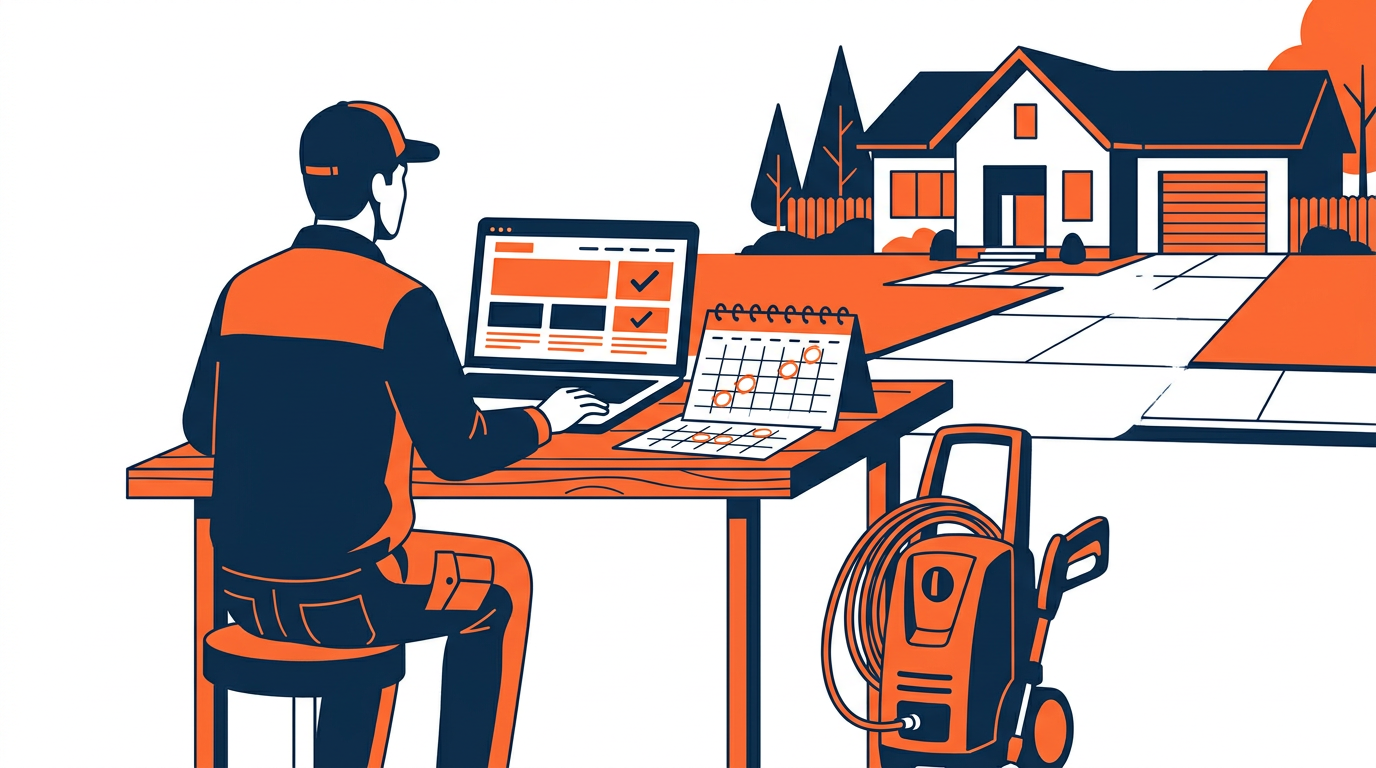
A solid pressure washing website usually takes 2 to 6 weeks to build. A basic template site can launch in several days if your photos, services, pricing approach, and business details are ready. A custom site with original copy, several service-area pages, quote forms, tracking, and search setup needs longer. The biggest delays usually come from missing content, slow approvals, and unclear service areas, not the actual page-building work.
Key takeaways
- Plan on 2 to 6 weeks for a complete contractor website.
- A basic template can launch in several days when all content is ready.
- Custom copy, location pages, integrations, and revisions extend the schedule.
- Launch a focused core site first, then add useful pages over time.
- Mobile testing, speed checks, and form testing belong inside the timeline.
A pressure washing website usually takes 2 to 6 weeks
Two to six weeks is a realistic working range for a professional pressure washing website. That covers planning, content, design, development, testing, revisions, and launch.
A one-page template can go live faster, sometimes within several days. That only works when your domain, logo, contact details, service list, coverage area, photos, and offer are already settled.
A larger custom build can take six weeks or longer. Original copy, multiple service pages, city pages, online estimating, automated follow-up, and several decision-makers all add work.
Do not confuse being online with being finished. A rushed site may technically load, yet still have weak calls to action, generic copy, broken forms, or poor mobile layouts.
The right deadline depends on what the site must do on day one. A new operator may need five strong pages and a dependable quote form. An established company may need separate residential, commercial, roof cleaning, and location sections.
Use the table below as a planning range, not a promise. Your readiness and approval speed can move every schedule.
| Website scope | Typical build time | What is usually included |
|---|---|---|
| Single landing page | 2 to 5 business days | One offer, service summary, contact form, phone call button |
| Basic template website | 1 to 3 weeks | Home, services, about, service area, contact |
| Custom local service website | 3 to 6 weeks | Original design, service pages, conversion copy, tracking, local search setup |
| Large custom website | 6 to 10 weeks or more | Many services, city pages, integrations, advanced forms, deeper revision rounds |
What happens during each website build phase?
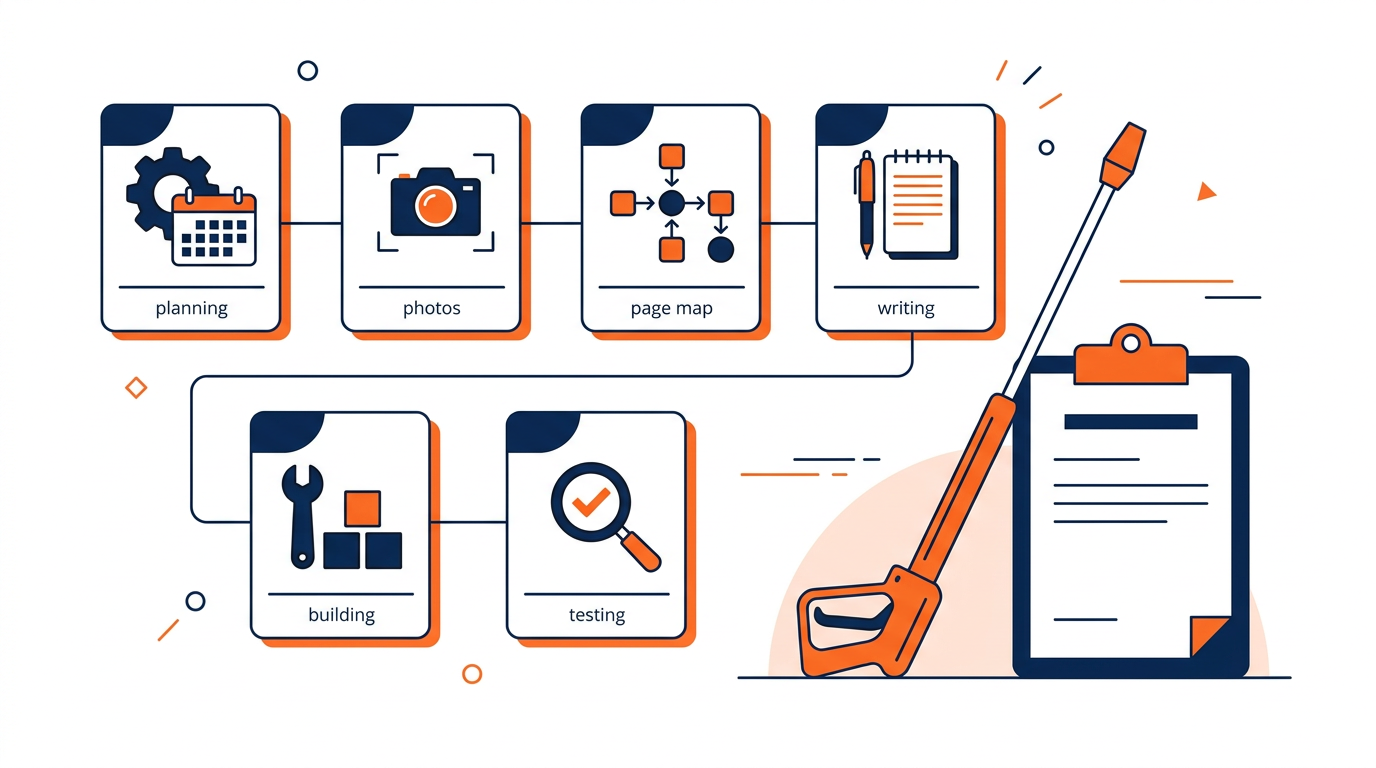
A clean build moves through six phases, with one clear approval at each stage. Skipping a phase usually creates rework later.
1. Define the job. Decide which services and locations deserve pages. Set one main action, usually calling or requesting a quote.
2. Gather the materials. Collect your logo files, phone number, email, business hours, service list, reviews, job photos, and company story. Review how to take pressure washing before and after photos that sell jobs before sending random camera-roll shots.
3. Map the pages. A small contractor site commonly starts with home, about, contact, service area, and core service pages. Each page needs a purpose instead of filling a navigation menu.
4. Write the copy. Explain what you clean, where you work, how customers request service, and what separates your process. Clear job details beat broad claims about quality.
5. Build and connect the site. The builder adds layouts, forms, click-to-call buttons, analytics, domain settings, and basic search fields. This phase also covers mobile formatting and image compression.
6. Test and launch. Submit every form, tap every phone button, check common screen sizes, proofread contact details, and confirm tracking. Connect Google Search Console after launch so you can monitor indexing and website performance in Google.
Content and design can overlap when approvals move quickly. Development should not start on pages whose purpose and copy remain unsettled.
What makes a pressure washing website take longer?
The timeline grows when scope, content, or approvals remain unclear. Most delays happen before and between the technical tasks.
Missing job photos: Sorting weak images, requesting originals, or waiting for new jobs can hold up several pages. Prepare horizontal and vertical options without customer faces or visible private information.
Unsettled services: Decide whether you sell house washing, concrete cleaning, roof washing, gutter work, commercial work, or a tighter mix. Your website structure depends on that decision. The guide to house washing vs pressure washing can help separate services customers often confuse.
Too many service areas: Every city page needs a real reason to exist and useful local information. Copying the same page repeatedly does not make the site helpful.
Changing the offer halfway through: Moving from phone calls to online estimates affects copy, forms, buttons, and tracking. Set the main conversion path before design approval.
Custom features: Pricing tools, scheduling connections, customer portals, financing widgets, and complex estimate forms require setup and testing. Even a simple pressure washing pricing calculator should reflect how you actually measure work before it influences website copy.
Slow feedback: One person should gather comments and approve each phase. Five separate text threads produce conflicts and repeated edits.
Unlimited revision habits: Changes are normal, but revisiting approved layouts after development adds time. Review each stage carefully, then close it.
You should compare scope before choosing between pressure washing website templates and custom websites. A template is faster when it already fits your offer. Custom work earns its longer schedule when your pages, workflow, or market require it.
What should you prepare before the website build starts?
Prepare one organized folder and one written business brief before kickoff. This can remove more delay than pushing the designer to work faster.
Your folder should contain the best available logo, brand colors, equipment or crew illustrations if used, real project photos, and review text you have permission to display. Label photos by service and location instead of uploading a pile of numbered files.
Your brief should list:
- Exact business name, phone number, email, and operating hours
- Primary cities or counties served
- Core services and services you do not provide
- Residential, commercial, or mixed customer focus
- Main call to action
- Estimate process and usual response method
- Insurance details you choose to mention accurately
- Common customer questions
- Domain and hosting access
- Existing analytics, listing, and email account access
Write down how you charge, even if the site does not publish prices. Your copywriter needs to understand minimums, measurements, and add-ons. Resources such as how much to charge for house washing help you settle the offer before writing starts.
Choose your page priorities from actual revenue goals. If concrete is your main service, give it a dedicated page instead of burying it under a general services paragraph.
Decide who owns the accounts. Your company should control its domain, website login, analytics, search tools, and connected business email. Save credentials securely rather than leaving ownership tied to a former employee or vendor.
A fast launch still needs mobile, speed, and form testing
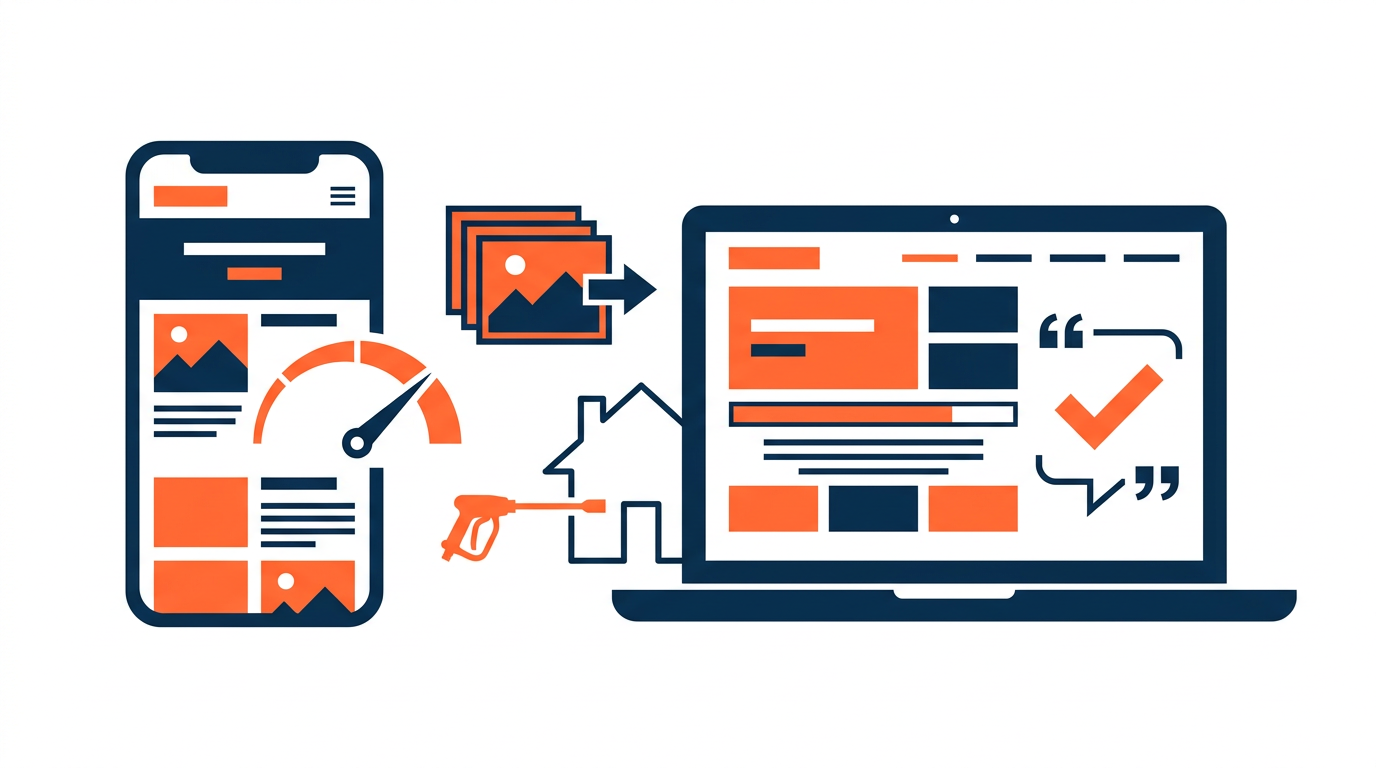
Do not shorten the schedule by skipping mobile or conversion testing. A site that looks fine on a laptop can still lose calls through slow pages, cramped buttons, or failed forms.
Mobile deserves special attention because 91 percent of US adults own a smartphone, according to the 2025 Pew Research Center survey. Pew also found that 16 percent are smartphone-only internet users who rely on their phones instead of home broadband. Review the Pew Research Center mobile fact sheet for the source data.
Test the homepage and every quote path on multiple screen sizes. Phone numbers should be tappable, forms should use reasonable fields, and important buttons should not require careful thumb placement.
Speed belongs in the launch checklist too. Portent's 2022 study of more than 100 million page views found that a website loading in one second had a conversion rate three times higher than one loading in five seconds. That does not mean every contractor site will produce the same result, but it shows why oversized job photos and unnecessary scripts deserve attention.
The Portent site speed and conversion research supports keeping pages lean. Compress images, avoid autoplay video, limit third-party tools, and test the live site rather than relying only on a preview.
Before launch, submit each form using a real test lead. Confirm the notification arrives, the reply address works, and the lead appears in any connected system. Test the call button, map link, social links, thank-you page, and spam protection.
Use the checklist in what makes a good pressure washing website to catch conversion problems before traffic reaches the site.
Launching the website does not mean it will rank immediately
A finished website is the starting point for search visibility, not the finish line. Google still needs to discover, process, and evaluate the pages against competing results.
Publishing more pages without a plan is not enough. Ahrefs reported in its 2023 study of roughly 14 billion pages that 96.55 percent of web pages received zero organic traffic from Google. That broad web finding does not predict your result, but it warns against treating page count as the goal.
A useful local search plan connects specific services with real service areas. The page should answer the searcher's job question, show relevant work, explain the next step, and link logically to related pages.
Start with accurate titles, clear headings, internal links, original service copy, and a sitemap submitted through Search Console. Then follow a practical pressure washing SEO guide instead of stuffing city names into every paragraph.
Your local listing also supports the website. Build or claim a Google Business Profile with accurate contact information, services, hours, and service areas. Google says customers are 2.7 times more likely to consider a business reputable when they find a complete Business Profile on Search and Maps.
Google also says customers are 70 percent more likely to visit and 50 percent more likely to consider purchasing from businesses with a complete profile. These figures apply to Business Profile completeness, not a guarantee that your website will rank or generate a specific number of jobs.
Website launch and local profile work can happen in parallel. Use this Google Business Profile setup for pressure washers to keep the listing work organized while the site is being built.
Should you launch quickly or wait for a larger custom site?
Launch a focused core site quickly when you currently have no credible web presence. Wait for a larger build only when the extra pages or features are necessary to handle your real sales process.
A new operator usually does not need 30 thin pages. Five to eight complete pages can explain the business, establish service coverage, and capture leads while later content is produced.
An established operator may need a longer first build. Separate crews, commercial bidding, many locations, recruiting, and multiple service lines can justify additional planning and integrations.
Do not let perfection keep your phone number off the web for months. You can launch the home page, core services, about page, service-area page, and contact page first. Add strong supporting pages after the forms, tracking, and customer response process work correctly.
Set two deadlines. The first is the minimum viable launch, containing everything needed to earn and handle a lead. The second covers additions such as service-area pages, project galleries, deeper FAQs, and educational articles.
Ask any builder for a written schedule showing what you must supply, how many revision rounds are included, and what counts as approval. Compare the timeline with the real cost of a DIY website versus hiring a web designer, because your own production time has value too.
If you want a contractor-focused build rather than assembling the site between jobs, you can get a WasherAuthority website. Bring your service list, coverage area, best photos, and account access to keep the schedule moving.
Frequently asked questions
Can I build a pressure washing website in one day?
You can publish a basic landing page in one day if the copy, photos, domain, and contact details are ready. Proper testing and a complete multi-page site usually require longer.
How many pages should the first website have?
A focused first site can work with five to eight complete pages. Prioritize the homepage, contact page, about page, service area, and your highest-value services.
Does custom website design always take longer?
Usually, because custom layouts, copy, integrations, and approvals add steps. A well-managed custom project can still move quickly when its scope and content are settled.
Should the website wait until I have more job photos?
Not necessarily. Launch with a smaller set of strong, relevant photos, then improve the gallery as you complete more work.
When should SEO work begin?
SEO planning should begin before the site structure and copy are approved. Ongoing page improvement, local listing work, and content continue after launch.
Need a website that turns these searches into calls?
We build done-for-you sites for pressure washing contractors. A one time build fee, then $29/month for hosting, your domain, backups and unlimited edits.
Get Your Free Mockup