The short answer
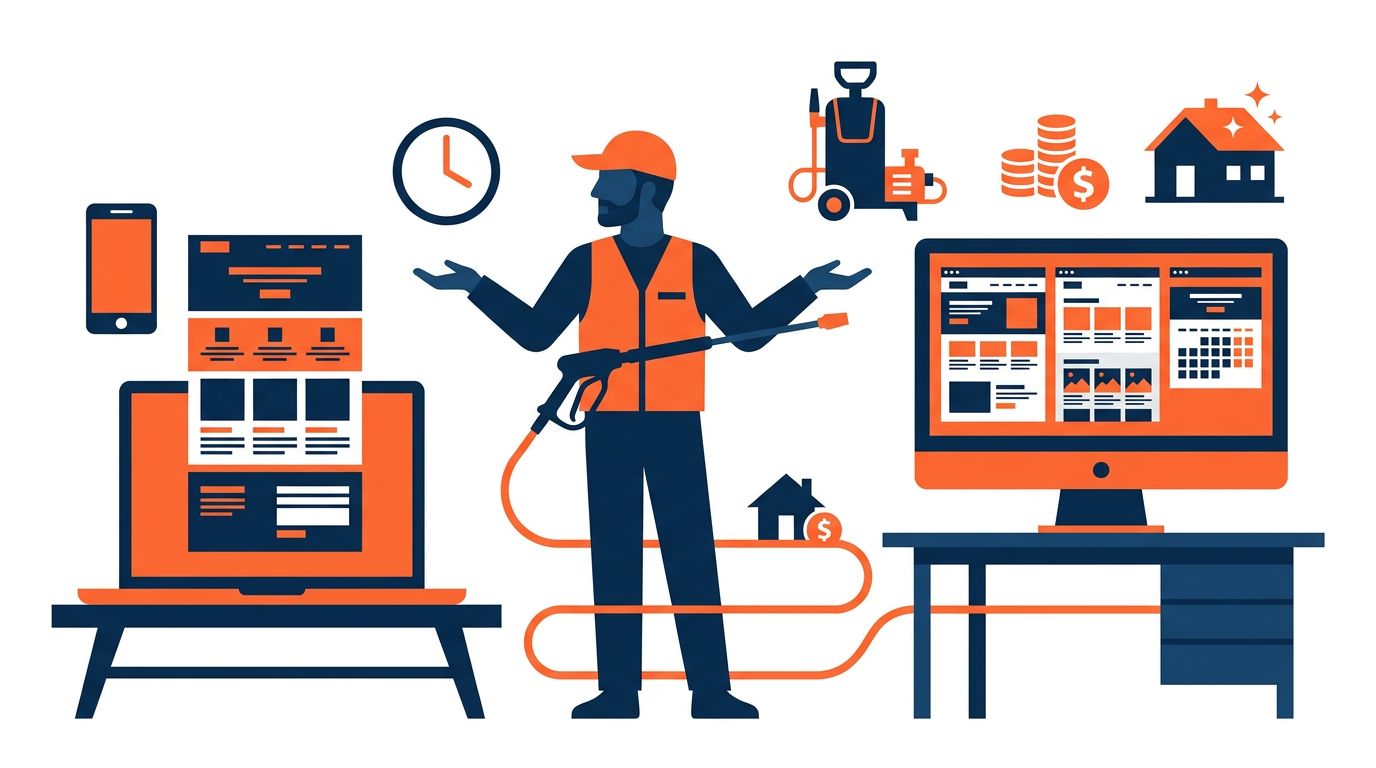
Build your own website if cash is tight, you have more time than booked work, and you can produce a clean mobile site. Hire a web designer if missed calls, slow pages, and weekend website work cost more than professional help. The real comparison has 7 parts: cash, labor, speed, copy, mobile performance, search setup, and ongoing control. For most established pressure washers, hiring wins. For a new operator testing the market, DIY is usually the practical starting point.
Key takeaways
- DIY saves upfront cash but makes you responsible for every page, form, update, and technical problem.
- Hiring usually fits an established operator whose time is better spent quoting, washing, and following up.
- A designer must understand local service businesses, not merely make attractive pages.
- Mobile speed, clear services, strong photos, and easy contact matter more than decorative effects.
- Compare written scope and ownership before comparing proposals.
Hiring wins for established operators, while DIY fits a cash-tight startup
The right choice depends less on business size than on your available cash, available hours, and tolerance for technical work. DIY fits an operator who needs a basic site now and can trade evenings for lower upfront spending.
Hiring fits you when the schedule is filling, you want more profitable jobs, or your current site is holding back calls. At that point, every Saturday spent resizing images or fixing a form competes with estimates, maintenance, and family time.
Competition also gives the decision weight. IBISWorld counted 32,193 pressure washing services businesses in the United States in 2024, up 5.2 percent from 2023. Your website does not need to be fancy, but it cannot look unfinished beside operators serving the same neighborhoods.
Do not confuse professional with expensive or custom with effective. Start by understanding Do You Really Need a $3,000 Pressure Washing Website?, then judge the scope against what your business actually needs.
Seven attributes show the real difference between DIY and hired website work
DIY gives you lower initial cash exposure and direct control, while hiring buys labor, judgment, and a faster path to a finished site. Neither option guarantees leads because publishing a website is only the starting line.
Ahrefs found that 96.55 percent of web pages received zero organic traffic from Google in its 2023 study of roughly 14 billion pages. That does not mean a website is useless. It means a page needs a clear local purpose, useful service information, sound search setup, and continued attention.
A template can work when you replace every generic line, organize services correctly, and make contact easy. The detailed tradeoffs between Pressure Washing Website Templates vs Custom Websites can help you decide how much customization you need.
Use the table as a scope checklist, not a promise that every designer handles every item. Ask who writes the copy, edits photos, connects forms, handles mobile layout, and maintains the site after launch.
| Attribute | DIY website | Hired web designer |
|---|---|---|
| Upfront cash | Usually the lower-cash route | Higher because you purchase labor and expertise |
| Your labor | High during setup and updates | Lower if the scope includes copy, images, and launch |
| Launch speed | Depends on your free time and learning curve | Can be faster with a defined process and deadline |
| Copy and structure | You write and organize every page | May be included, but confirm it in writing |
| Mobile performance | Your responsibility to test and improve | Should be handled, tested, and demonstrated |
| Local search setup | You research titles, pages, indexing, and tracking | May be included, but SEO scope varies |
| Ongoing control | Direct control if accounts are in your name | Depends on ownership, access, and maintenance terms |

The real website cost includes your labor and lost operating time
The honest cost is cash paid plus your hours, delayed launch, and future maintenance. A cheap builder becomes expensive when it absorbs several work nights and still leaves the quote form broken.
Price your own time before choosing. Estimate the hours needed for page planning, writing, image selection, layout, mobile testing, form setup, revisions, and launch. Multiply those hours by what that time is worth elsewhere in your operation.
Do not automatically value every DIY hour at your full job revenue. Travel, materials, overhead, weather, and unfilled schedule gaps affect the comparison. Use a conservative hourly value tied to work you could realistically complete or business tasks you are postponing.
Hiring has hidden costs too. You may still need to provide service details, service areas, photos, pricing direction, account access, and revision feedback. A vague proposal can also create later charges for pages, edits, hosting, search work, or form changes.
The purchase model matters as much as the build. Compare One-Time vs Monthly Pressure Washing Websites before signing, because the cheapest first payment may not produce the lowest long-term cost.
Mobile speed and contact flow matter more than visual polish
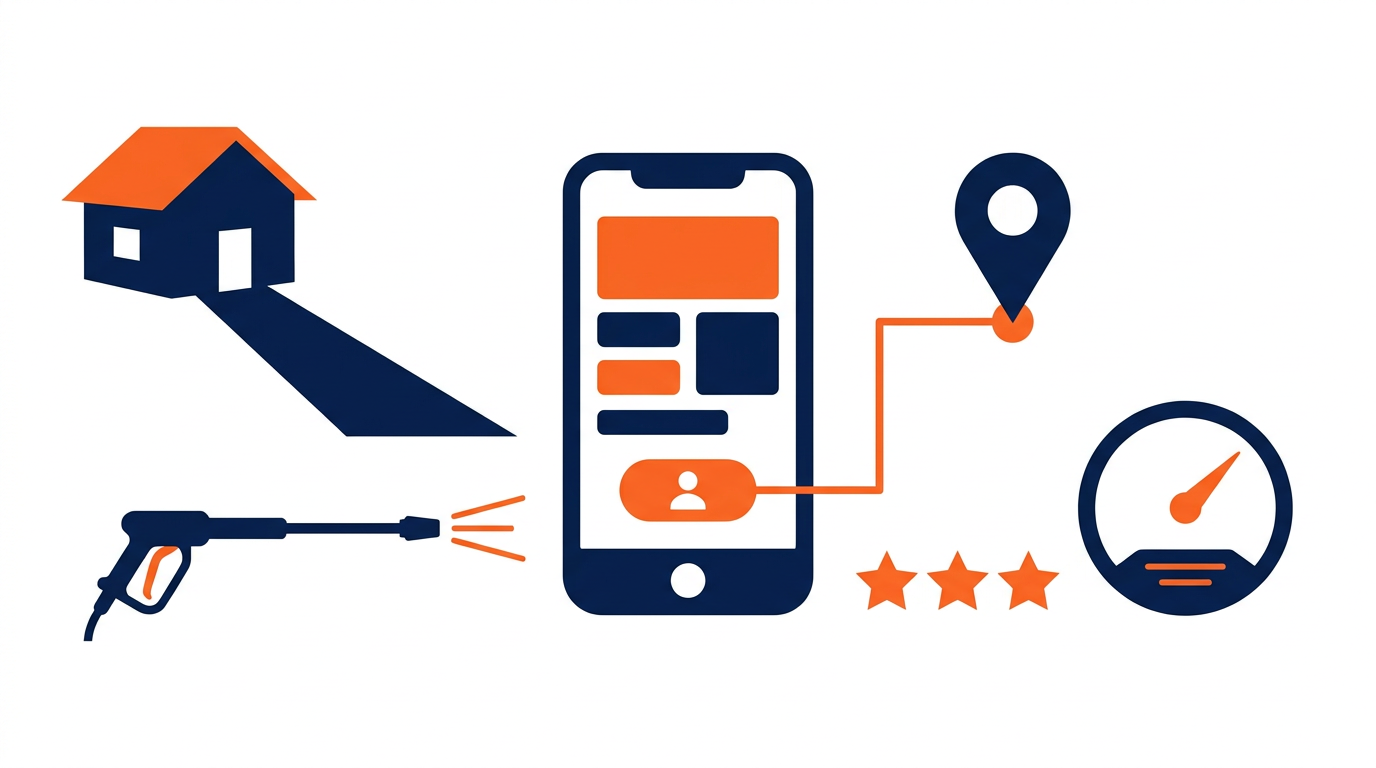
Your site must load quickly on a phone and make calling or requesting a quote obvious. A beautiful desktop layout that drags on mobile is a weak sales tool.
Pew Research Center reported in 2025 that 91 percent of US adults own a smartphone. It also found that 16 percent are smartphone-only internet users who rely on their phone instead of home broadband. Test the site on an actual phone, not only in a desktop preview.
Speed deserves direct attention. Portent's 2022 study of more than 100 million page views found that a site loading in one second had a conversion rate three times higher than one loading in five seconds. That research is broader than pressure washing, but the operational lesson is clear: do not bury a simple quote request under oversized images, animation, and unnecessary scripts.
Check whether a visitor can identify your service area, choose a service, see credible work, and contact you without hunting. The checklist in What Makes a Good Pressure Washing Website: The 9 Elements That Convert gives you a practical standard for either route.
If you hire, ask the designer to show mobile tests and explain image compression. If you build it, keep layouts simple and retest after adding every gallery, form, or plug-in.
A website needs local search and review support to earn attention
A finished website alone does not put you at the top of local results. It needs focused service pages, accurate business details, a complete Google profile, strong proof, and a plan for earning reviews.
Backlinko's analysis of four million search results found that the top three Google results received 54.4 percent of all clicks. This is why a designer who only discusses colors and animations is missing a major part of the job.
Reviews also shape the handoff from search to contact. According to the BrightLocal Local Consumer Review Survey, 97 percent of consumers read online reviews for local businesses in 2026. The same survey found that 68 percent would only use a business rated four stars or higher.
Connect the site to a properly maintained listing by following Google Business Profile Setup for Pressure Washers. Then use Google Search Console to monitor whether Google can find your pages and how they perform in search.
Neither tool replaces useful pages. Build separate, specific information around the services and locations you actually cover, and make sure every page helps a homeowner take the next step.
Choose DIY, a freelancer, or a specialist based on your current bottleneck
Choose DIY when cash is the bottleneck, hire a freelancer when execution is the bottleneck, and consider a specialist when lead quality and local search are the bottlenecks. Match the solution to today's problem rather than buying for a business you might become later.
Choose DIY when:
- You are launching and need a credible online home base.
- You can write clearly about your services and service area.
- You have usable job photos and time to learn the platform.
- You accept that search visibility and refinements will take continued work.
Compare a few tools using Best Website Builder for a Pressure Washing Business. Pick the one you can maintain without calling technical support for every text change.
Choose a general freelancer when:
- You have the message and photos but lack build time.
- You need a straightforward brochure site with quote capture.
- You can give detailed direction and review the work carefully.
Choose a pressure washing website specialist when:
- Your current site gets traffic but weak inquiries.
- You need service structure, local pages, copy, tracking, and ongoing help.
- You want someone who already understands house washing, concrete, roofs, and service areas.
Review Best Pressure Washing Website Design Companies (2026 Buyer Guide) using the same requirements for every provider. Industry familiarity helps, but ownership, performance, communication, and measurable scope still decide the deal.
A written scope protects you from weak builds and surprise charges
Do not hire from a homepage screenshot alone. Get a written scope covering pages, copy, images, forms, mobile testing, basic search setup, ownership, revisions, launch support, and ongoing charges.
Ask these questions before paying:
- Who owns the domain, website files, analytics, and business accounts?
- Who writes the service and location copy?
- How many pages and revision rounds are included?
- Will you compress images and test forms on common phone sizes?
- What search setup and tracking are included?
- What happens if we stop monthly service?
- Can another provider move or edit the site later?
- Who handles updates, backups, security, and broken forms?
Also ask to see live contractor sites rather than polished mockups. Open those sites on your phone, tap every contact option, and check whether the service message is clear within seconds.
A designer should explain tradeoffs in plain language. If the proposal hides ownership, locks essential accounts away from you, or promises rankings without explaining the work, slow down.
Once you know the pages and support you need, you can get a WasherAuthority website or use the same checklist to evaluate another provider. The point is to buy a working lead path, not an impressive presentation.
Frequently asked questions
Can a DIY pressure washing website rank on Google?
Yes, but the builder alone does not create rankings. You still need useful service pages, accurate local information, sound technical setup, and ongoing search work.
Should I build a website before creating a Google Business Profile?
Set up both early. The profile supports visibility in Google Search and Maps, while the website gives homeowners fuller service details and a direct quote path.
What pages should a basic pressure washing website have?
Start with a home page, core service pages, service-area information, an about or trust page, and a clear contact or quote page.
Do I need custom website copy?
You need specific copy, whether you write it or hire it out. Generic template text does not explain your process, service area, property types, or reasons to call.
Who should own my domain and website accounts?
Your business should control the domain and essential accounts. Give providers the access they need, and document what happens to the website if the relationship ends.
Need a website that turns these searches into calls?
We build done-for-you sites for pressure washing contractors. A one time build fee, then $29/month for hosting, your domain, backups and unlimited edits.
Get Your Free Mockup