
The short answer
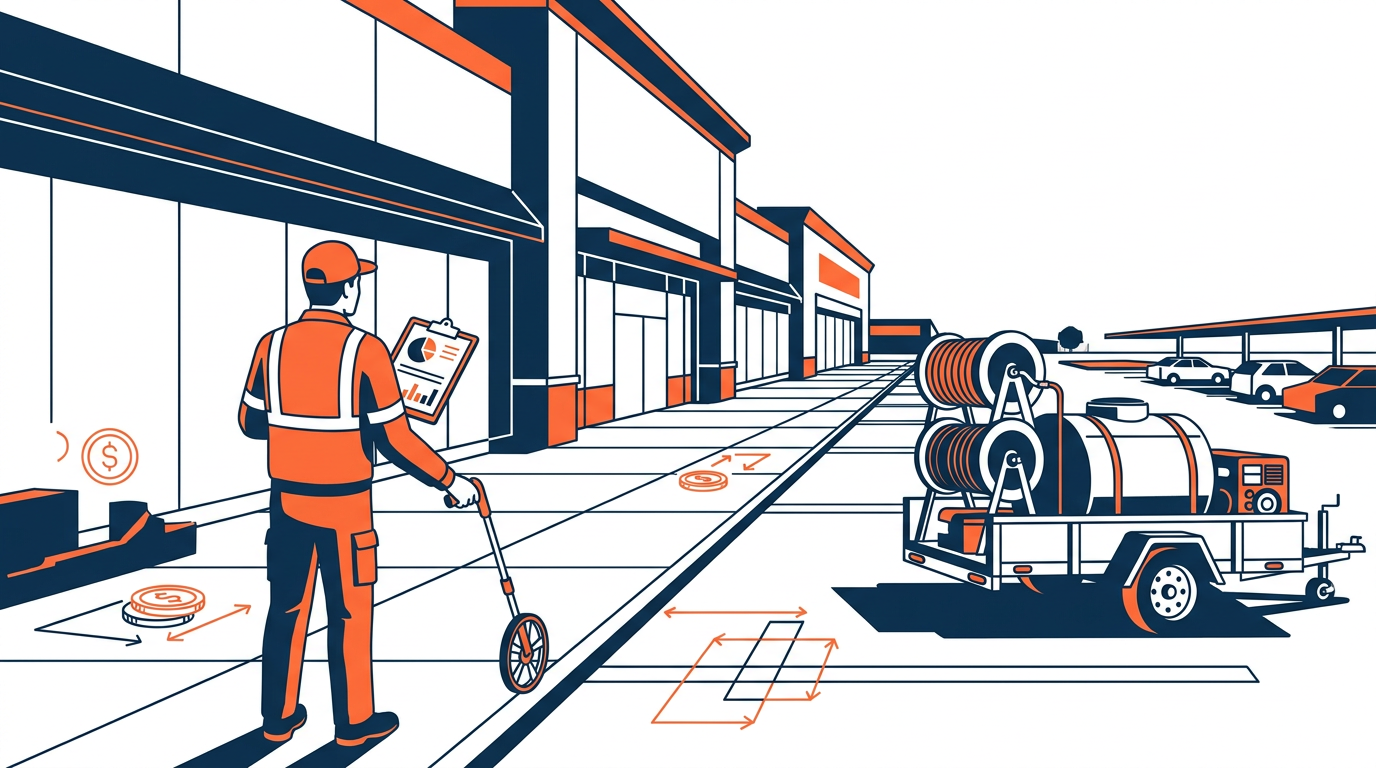
Commercial pressure washing rates usually work best at $0.20 to $0.55 per square foot for open concrete, with concrete sealing at $0.75 to $1.25 per square foot. Use hourly or flat-rate pricing when access, grease, gum, equipment movement, or water recovery makes production uncertain. Set a commercial minimum of roughly $250 to $500, then raise it for night work, mobilization, lifts, or recovery requirements. Your final quote must cover labor, chemicals, equipment, insurance, travel, overhead, and profit.
This video lays out a data-driven system for pricing commercial pressure washing jobs so you protect your margin instead of working for free. It covers baseline per square foot rates, when to price by the square foot versus by the hour, how to stack your true job costs, the obstacles that quietly kill production speed, setting a working minimum, and what every commercial bid needs in writing.
In this video
- Bigger square footage does not mean a lower rate. Volume only cuts your cost per square foot when the crew can move without obstacles, detail work, or access interruptions.
- Baseline rates: open concrete 20 to 35 cents per square foot, tight or obstructed concrete 35 to 55 cents, concrete sealing 75 cents to $1.25. Treat these as a starting point, then verify against an hourly check.
- Use square foot pricing for predictable open jobs, an hourly allowance when access is restricted or spot work is involved, and hybrid pricing to confirm the total against your required crew hour revenue.
- Build every quote in layers: labor hours times true loaded labor cost, plus chemicals, fuel, and wear, plus special equipment, plus allocated overhead, plus profit. Insurance alone averages about $895 a year for general liability and $1,601 for workers comp (Insureon).
- Price movers slow production: bollards, curbs, stairs, planters, furniture, grease and gum, water access and recovery, and schedule constraints like night work or locked gates. Bill these separately, never bury them in the base rate.
- Set a working minimum of $250 to $500 to cover mobilization, and put scope in writing: name each surface, state stain exclusions, define who supplies water and power, and put extra work behind a written change order.
Show full transcript
Let's build a mathematically sound blueprint for pricing commercial pressure washing jobs. If you have been in the industry for any amount of time, you already know the commercial space can be lucrative. But without a strict, data-driven approach to your quotes, it is also easy to accidentally end up working for free. So today we break down the exact strategies, numbers, and formulas you need to protect your margins and scale your operation.
First, we need to shatter a common myth. Larger square footage does not automatically mean a cheaper per square foot rate. It is tempting to look at a massive commercial lot and assume the sheer volume means you can discount your rate. Here is the reality: volume only lowers your setup cost per square foot when your crew can keep moving without obstacles, detailed work, or interrupted access. If those elements are not smooth, that massive property can turn into a massive liability.
Here is the road map: set your baseline rates, choose the pricing model, calculate your true job costs, navigate the price movers, establish your working minimums, and craft the winning bid.
Section one: setting your baseline rates. Anchoring your pricing is crucial. As a starting point, open concrete generally ranges from 20 to 35 cents per square foot, which fits large, repeatable areas. The moment you introduce small obstructions, that jumps to 35 to 55 cents. And for concrete sealing, you are looking at 75 cents up to $1.25. Remember, this is just a starting framework. You still have to walk the property, test the surface, estimate your production, and compare your square foot total against an hourly cost check.
Section two: choosing the pricing model, square foot versus hourly. Square foot pricing works beautifully for predictable jobs. Think parking decks, loading pads, dumpster pads, and warehouse aprons, places where the scope is clear. It gives the customer a simple total. On the flip side, use an hourly allowance when your crew has to deal with access restrictions, move hoses around active doors, do repeated spot treatments, or wait for parked cars to move. An hourly allowance protects you, and you can show it as a separate line item without exposing every internal cost of your business.
That brings us to the safest approach, hybrid pricing. It is the best of both worlds so you never get caught working for free. You measure the base cleaning by the square foot, add fixed charges for special conditions, and then confirm that final total against your required crew hour revenue. If the math does not check out on both sides, you do not send the quote.
Section three: calculating true job costs, or protecting your profit. Every quote you build has to stack these layers before you submit it. First, calculate estimated labor hours for loading, travel, setup, the actual cleaning, breakdown, and disposal. Then multiply by your true labor cost, which has to include payroll burden. Next, add your chemicals, fuel, and wear items. If the job needs lifts, hot water equipment, or traffic control, that goes in too. Also allocate your overhead, things like office costs and software, across realistic billable work, not every hour on the calendar. Finally, stack your required profit margin on top.
To put overhead in perspective, look at insurance. Based on industry data from Insureon for pressure washing companies, general liability averages around $895 annually and workers comp averages about $1,601. These are industry averages, not exact quotes for your company, so plug in your own actual premiums to find your true cost of doing business. If you ignore these hidden overhead costs, they will quietly eat your profit margin alive.
Section four: navigating the price movers, the obstacles that ruin margins. Physical obstacles slow your production speed, which means two properties with the same square footage can require very different crew hours. With large open pavement, you can support a lower square foot rate because setup and edging are spread out. But the moment you introduce bollards, planters, curbs, stairways, or heavy outdoor patio furniture, the job slows to a crawl. You have to account for the time it takes to navigate around these elements.
Never bury unlimited spot removal or water recovery into a low concrete rate. Those require separate line items. Grease and gum need specific attention, so define whether you are doing a basic pass, counting quantity, or a separately approved treatment. Water access is another big one. Confirm the connection location, the flow, permission to use it, and exactly what capture, filtration, or disposal the customer expects for runoff. And schedule changes, night work, restricted service windows, locked gates, and required security escorts all add paid time for your crew without adding a single cleanable square foot.
Section five: establishing your working minimums. A practical starting minimum for ordinary commercial work is roughly $250 to $500, and you need to command respect for that figure. A minimum covers the essential time that raw square footage misses. Even on a tiny job, your crew still has to load equipment, drive out, find the site contact, set up, document the work, and break down, and your office still has to send an invoice. Do not stop at the base minimum. Raise it transparently for night access, distant mobilization, multiple machines, or extensive paperwork. If your operation needs it, set multiple minimums: a daytime minimum, a higher after-hours minimum, and a separate mobilization threshold for distant properties. If 600 square feet at 30 cents produces $180, quote the $250 minimum clearly. Do not hide the difference behind an artificially inflated square foot rate. Just be straight up.
Section six: crafting the winning bid, putting it in writing. A clear scope that outlines exclusions, payment terms, and utility access protects your margin far better than a list of vague promises. Name every area separately. Sidewalks are separate from dumpster pads. Walls are separate from loading zones. Describe the intended result without guaranteeing full removal of every stain, and explicitly list things like oil, rust, or gum that require separate approval. State clearly who provides the water and power. Put any additional work behind a written change order with unit rates. If it is recurring work, spell out the frequency and include a reset clause for skipped service or unusual spills, because a maintenance rate should never force you to absorb restoration level labor.
Run through a final checklist before sending the quote. Walk the route your hoses will take to expose missing labor like stairs or traffic crossings. Review every add-on, grease, gum, lifts, and after-hours access, and make sure they are not disappearing into your base wash price. Confirm exactly who authorizes the work and how their purchase order process works. Do not start recurring work with unclear authorization. And verify that if production runs slightly slower than expected, your total still keeps your business in the green.
So grab these formulas, set your minimums, map out those obstacles, and take control of your commercial quoting. Stop racing to the bottom just because there are thousands of competitors out there. Make your scope easy to compare, base your bids on hard data and actual crew hours, and protect your profitability on every job. Before you send your next bid, ask yourself: are you actually charging for the complexity, or are you working for free?
Key takeaways
- Quote measurable, repeatable surfaces by square foot, then check the result against labor hours.
- Use a $250 to $500 working minimum for ordinary commercial mobilization.
- Open commercial concrete can fall within the $0.20 to $0.55 per-square-foot concrete range.
- Charge separately for grease, gum, water recovery, lifts, night access, and sealing.
- Put exclusions, service frequency, payment terms, and change-order pricing in writing.
What are workable commercial pressure washing rates?
Start open commercial concrete within the $0.20 to $0.55 per-square-foot working range. The low end fits large, open, repeatable areas, while the high end fits smaller or slower surfaces.
Commercial work is not automatically cheaper because the property is larger. Volume lowers setup cost per square foot only when your crew can keep moving without obstacles, detail work, or interrupted access.
Use the table as a starting framework, not a promise. Walk the property, test the surface when needed, estimate production, and compare your square-foot total with an hourly cost check.
For concrete-specific bidding, review How Much to Charge for Driveway and Concrete Cleaning. The residential setting differs, but the surface measurement and production logic still apply.
| Commercial service or condition | Working pricing method | Working rate or treatment |
|---|---|---|
| Open sidewalks and broad concrete areas | Per square foot | $0.20 to $0.35 per sq ft |
| Smaller, obstructed, or heavily detailed concrete | Per square foot | $0.35 to $0.55 per sq ft |
| Concrete sealing after proper preparation | Per square foot | $0.75 to $1.25 per sq ft |
| Storefront walls or exterior building surfaces | Measured area plus complexity | Use the $0.25 to $0.35 house-wash anchor only as a baseline, then adjust for commercial access and scope |
| Grease, gum, rust, paint, or spot treatment | Separate line item | Price after testing labor, chemical use, and removal limits |
| Uncertain cleanup, equipment movement, or standby time | Hourly or crew-hour allowance | Build from your own loaded hourly cost |
| Recurring route work | Per visit or monthly agreement | Price each visit first, then adjust only for proven efficiency |
When should you charge by square foot, hour, or flat rate?
Charge by square foot when the area is measurable and production is predictable. Use hourly or flat-rate pricing when unknown labor, detailed work, or access restrictions control the job.
Square-foot pricing works well for parking decks, sidewalks, loading pads, dumpster pads, and warehouse aprons when the scope is clear. It gives the customer a simple total and lets you compare similar properties.
An hourly allowance protects you when the crew may wait for parked cars, move hoses around active doors, or perform repeated spot treatment. You can show that allowance as a separate line item without exposing every internal cost.
A flat rate is useful for a defined storefront, dumpster area, or scheduled maintenance visit. Build that flat rate from measurements and expected hours, not from what the number feels like.
The practical approach is hybrid pricing. Measure the base cleaning by square foot, add fixed charges for special conditions, then confirm the total against your required crew-hour revenue. See Per Square Foot vs Flat Rate Pricing for Pressure Washing for a deeper breakdown.

How do you calculate a profitable commercial quote?
Add direct job costs, allocated overhead, and required profit before sending the quote. A competitor's number does not tell you whether your own crew can perform the work profitably.
Start with estimated labor hours for loading, travel, setup, cleaning, breakdown, and disposal. Multiply those hours by your true labor cost, including payroll burden where applicable.
Then add chemicals, fuel, wear items, equipment allocation, water-related costs, and subcontractors. Include lifts, hot-water equipment, traffic control, or recovery equipment when the scope requires them.
Insurance belongs in overhead. Insureon reports average annual costs of $895 for general liability insurance and $1,601 for workers compensation insurance for pressure washing companies. Those are averages, not quotes for your company, so use your actual premiums in the calculation.
Allocate office costs, software, estimating time, vehicle expense, marketing, and nonbillable maintenance. Divide those costs across realistic billable work, not every hour on the calendar.
Finally, add profit after costs. Run your measurements through the Pressure Washing Pricing Calculator, then compare the calculated price with the crew hours you expect. If the quote fails either check, fix the scope or price before submitting it.
What moves a commercial pressure washing price up or down?
Production speed, contamination, access, and site rules move the price more than raw square footage. Two properties with equal area can require very different crew hours.
Large, open pavement generally supports a lower square-foot rate because setup and edging are spread across more area. Bollards, planters, curbs, stairways, parked vehicles, outdoor furniture, and pedestrian traffic slow the job.
Grease and gum need separate attention. Do not bury unlimited spot removal inside a low concrete rate. Define whether the proposal includes a basic pass, a counted quantity, a time allowance, or a separately approved treatment.
Water access matters. Confirm connection location, flow, permission to use it, and whether you must bring water. Also identify where runoff may travel and what capture, filtration, or disposal tasks the customer expects. Price the specified work and equipment rather than assuming a universal requirement.
Schedule changes the labor plan. Night work, restricted service windows, tenant coordination, locked gates, alarm procedures, and required escorts can add paid time without adding cleanable square footage.
Vertical surfaces, loading docks, roofs, and elevated details introduce different production and access issues. If roofing is included, separate it from ground cleaning and use a dedicated scope informed by How Much to Charge for Roof Soft Washing.
Frequency can lower setup or soil-removal time after you verify the pattern. Do not discount a recurring contract before you know what the first service requires.
What minimum charge should you set for commercial work?
A practical starting minimum is $250 to $500 for ordinary commercial work. Raise it when travel, night access, multiple machines, water recovery, or extensive paperwork increases mobilization.
A minimum covers the time that square footage misses. Your crew still loads equipment, drives, finds the contact, sets up, documents the work, breaks down, and sends an invoice on a small job.
Set more than one minimum if your operation needs it. You might have a local daytime minimum, a higher after-hours minimum, and a separate mobilization threshold for distant properties or specialized equipment.
Apply the minimum transparently. If 600 square feet at $0.30 produces $180, quote the $250 minimum rather than hiding the difference in a strange square-foot rate.
For several small areas at one property, combine them when one setup serves the entire visit. For multiple addresses, charge mobilization by site unless the route and schedule create real savings.
What should every commercial pressure washing bid include?
Every bid should define surfaces, measurements, cleaning level, schedule, access, exclusions, and payment terms. A clear scope protects your margin better than a long list of vague promises.
Name each area and quantity. Separate sidewalks, storefronts, dumpster pads, loading zones, walls, curbs, and sealing so the customer can see what the total covers.
Describe the intended result without guaranteeing full removal of every stain. Note any test areas and list oil, rust, paint, oxidation, efflorescence, gum, or organic staining that requires separate approval.
State who supplies water and power, who moves vehicles or furniture, and who controls pedestrian access. Include the service window, expected interruptions, and what happens if the site is not ready.
Put additional work behind a written change order. Give the customer a unit rate, fixed add-on, or approved hourly basis before your crew expands the scope.
Commercial buyers may request insurance documentation, vendor forms, photos, or invoicing through a portal. Confirm those tasks during estimating and price the administrative time when it is material.
How should you price recurring commercial cleaning?
Price the first visit from the full scope, then price recurring visits from the expected maintenance workload. Never promise a discount until you understand access, soil buildup, and payment behavior.
Spell out frequency and included areas. Weekly dumpster-pad service is not the same scope as quarterly sidewalks, even when both appear under one property contract.
Use a per-visit price when the schedule may change. Use a monthly amount when visit frequency is fixed, but state the number of included visits and the charge for extras.
Add a reset clause for skipped service, construction debris, tenant events, or unusual spills. A maintenance rate should not force you to absorb restoration-level labor.
Competition is real. IBISWorld counted 32,193 pressure washing services businesses in the United States in 2024, which was 5.2 percent higher than in 2023. That does not mean you should race to the bottom. Make your scope easy to compare and your response process dependable.
A professional estimate page also helps property managers understand your service area and request the right details. If your current site cannot support that process, review how to Get a WasherAuthority website.
What should you check before submitting the commercial quote?
Check measurements, crew hours, special costs, exclusions, and the minimum before sending the quote. Then confirm that the total still works if production is slower than expected.
Walk the route your hoses and equipment will take. Count separate setups, water connections, stairs, locked areas, curbs, and traffic crossings. These details often expose missing labor.
Review every add-on. Grease treatment, gum removal, sealing, lifts, recovery, after-hours access, and extra mobilization should not disappear inside the base wash price.
Confirm the decision maker, billing contact, purchase-order process, and payment timing. Do not start recurring work with unclear authorization.
Keep the proposal readable. One base scope, clear options, specific exclusions, and a defined approval process are easier to manage than one crowded lump sum.
Frequently asked questions
Should commercial pressure washing always cost less per square foot than residential work?
No. Large open areas may support a lower rate, but access rules, contamination, night work, recovery, and documentation can raise the total.
Do you charge separately for gum and grease removal?
Yes, when the quantity or removal time is uncertain. Use a counted allowance, fixed add-on, or approved hourly treatment.
Can you discount a recurring commercial contract?
Only after the schedule creates measurable efficiency. Price the initial cleanup and each visit honestly before offering any recurring adjustment.
Should concrete sealing appear in the same quote?
It can, but list it separately. A working range for concrete sealing is $0.75 to $1.25 per square foot after suitable preparation.
How long should a commercial pressure washing quote remain valid?
Choose a period that fits your chemical, labor, fuel, and subcontractor exposure. State the expiration date directly on the proposal.
Need a website that turns these searches into calls?
We build done-for-you sites for pressure washing contractors. A one time build fee, then $29/month for hosting, your domain, backups and unlimited edits.
Get Your Free Mockup